…the old
“Beyond Mapping III” book (30 Topics)
has been divided into
two books (10 Topics each with Further
Reading)
You are encouraged to access the revised Beyond Mapping Compilation Series posted at
http://www.innovativegis.com/basis/BeyondMappingSeries/
__________________________________________________________________
|
Chronological
Listing of Beyond Mapping Columns by Joseph K. Berry appearing in GeoWorld
(formally GIS World) magazine from 1989 through present <Click here>
right-click to download a printer-friendly version of this listing (.pdf). The
compilation of Beyond Mapping columns is organized into three groups— Beyond Mapping III: A Compilation of Beyond Mapping Columns is
an online book organizing the columns from 1996 to 2013 into 30
Topics, Introduction and Epilog Beyond Mapping II: A Compilation of Beyond Mapping Columns is
an online book organizing the columns from 1993 to 1996 into 10
Topics, Introduction and Epilog Beyond Mapping I: A Compilation of Beyond Mapping Columns is an online book
organizing the columns from 1989 to 1993 into 10 Topics, Introduction
and Epilog …click
on hyper links below to access the postings; click on any of the figures
to pop-up a high resolution graphic.
Permission to use portions
of the collection for educational and non-commercial purposes is granted
provided reference is made to the author and this online compilation. Notes: Recent Beyond Mapping columns also can be
accessed via http://www.geoplace.com, select the “News”
item at the top-left, then “Articles/Columns & Archives” and from
the second “or search by” pick list choose “Beyond Mapping.” Most of the processing and figures discussed in these
online papers were derived using MapCalcTM software. See www.innovativegis.com,
“Software” section to download a free MapCalc Learner version with
tutorial materials for classroom and self-learning map analysis concepts and
procedures. |
_____________________________________________________________________________________
|
Beyond
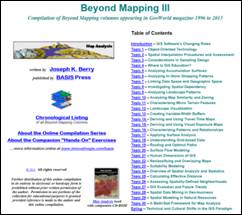
Mapping III: A Compilation of Beyond Mapping Columns …is an online book
organizing the Beyond Mapping columns first published in GeoWorld (formally GIS
World) from 1996 to 2013 into 28 Topics, Introduction and Epilog. |
Note: click on the
hyperlinks below to access the columns compiled into the Beyond Mapping III
online book.
|
…columns below
(highlighted in tan) were published since the Map Analysis
book/CD release (after January, 2007) |
|||
|
12 |
December |
2013 |
Where
Do We Go from Here? — Swan Song after 25 years of
Beyond Mapping columns |
|
11 |
November |
2013 |
The
Good, the Bad and the Ugly Sides of GIS — discusses
the potential of geotechnology to hinder (or even thwart) societal progress |
|
10 |
October |
2013 |
Laying
the Foundation for SpatialSTEM: Spatial Mathematics, Map Algebra and
Map Analysis — discusses the conceptual foundation and intellectual
shifts needed for SpatialSTEM |
|
9 |
September |
2013 |
The
Spatial Key to Seeing the Big Picture — describes a five step
process for generating grid map layers from spatially tagged data |
|
8 |
August |
2013 |
Generating
Mountains and Molehills from Field Sampled Data — creating
an elevation surface from field sampled data |
|
7 |
July |
2013 |
In
Search of the Elusive Image — describes extended geo-query
techniques for accessing images containing a location of interest |
|
6 |
June |
2013 |
Setting
a Place at the Table for Grid-based Data — describes the differences
between individual file and table storage approaches |
|
5 |
May |
2013 |
Mixing
It up in GIS Modeling’s Kitchen — an overview of map analysis
and GIS modeling considerations |
|
4 |
April |
2013 |
Spatially
Evaluating the T-test — illustrates the expansion of traditional
math/stat procedures to operate on map variables to spatially solve
traditional non-spatial equations |
|
3 |
March |
2013 |
Depending
on Where is What — develops an organizational structure for spatial
statistics |
|
2 |
February |
2013 |
Recasting
Map Analysis Operations for General Consumption — reorganizes ArcGIS’s
Spatial Analyst tools into the SpatialSTEM framework that extends traditional
math/stat procedures |
|
1 |
January |
2013 |
Optimal
Path Density is not all that Dense (Conceptually) — uses Optimal Path
Density Analysis to identify “corridors of common access” |
|
12 |
December |
2012 |
Bringing
Travel and Terrain Directions into Line — describes comparison procedures and route evaluation techniques |
|
11 |
November |
2012 |
Just
How Crooked Are Things? — discusses distance-related metrics
for assessing crookedness |
|
10 |
October |
2012 |
To
Boldly Go Where No Map Has Gone Before — identifies Lat/Lon as a
Universal Spatial Key for joining database tables |
|
9 |
September |
2012 |
Organizing
Geographic Space for Effective Analysis — an overview of data
organization for grid-based map analysis |
|
8 |
August |
2012 |
Altering
Our Spatial Perspective through Dynamic Windows — discusses the three
types of roving windows— fixed, weighted and dynamic |
|
7 |
July |
2012 |
Narrowing-In
on Absurd Gerrymanders — discusses how a Narrowness Index (NI) can be
applied to assess redistricting configurations |
|
6 |
June |
2012 |
Questioning
GIS in Higher Education — describes thoughts and notes from a panel
discussion on “GIS in Higher Education” |
|
5 |
May |
2012 |
Infusing
Spatial Character into Statistics — describes a statistical structure
for spatial statistics operations |
|
4 |
April |
2012 |
Simultaneously
Trivializing and Complicating GIS — describes a mathematical structure
for spatial analysis operations |
|
3 |
March |
2012 |
Paint
by Numbers Outside the Traditional Statistics Box —
discusses the nature of Spatial Statistics operations |
|
2 |
February |
2012 |
Map-ematically
Messing with Mapped Data — discusses the nature of
grid-based mapped data and Spatial Analysis operations |
|
1 |
January |
2012 |
SpatialSTEM
Has Deep Mathematical Roots — provides a conceptual
framework for a map-ematical treatment of mapped
data |
|
12 |
December |
2011 |
VtoR and Back! — describes various techniques
for converting between vector and raster data types |
|
11 |
November |
2011 |
Contour
Lines versus Color Gradients for Displaying Spatial Information — discusses
the similarities and differences between discrete contour line and continuous
gradient procedures for visualizing map surfaces |
|
10 |
October |
2011 |
The
Universal Key for Unlocking GIS’s Full Potential — outlines a
global referencing system approach compatible with standard DBMS systems |
|
9 |
September |
2011 |
Assessing
Wildfire Response (Part 2): Jumping
Right into It — describes map analysis procedures for determining initial
response time for alternative attack modes |
|
8 |
August |
2011 |
Assessing
Wildfire Response (Part 1): Oneth by Land, Twoeth by
Air — discusses a spatial model for determining effective
helicopter landing zones |
|
7 |
July |
2011 |
Extending
Information into No-Data Areas — describes a technique for
“filling-in” information from surrounding data into no-data locations |
|
6 |
June |
2011 |
Breaking
Away from Breakpoints — describes the use of curve-fitting
to derive continuous equations for suitability model ratings |
|
5 |
May |
2011 |
Correlating
Maps and a Numerical Mindset — describes a Spatially
Localized Correlation procedure for mapping the mutual relationship between
two map variables |
|
4 |
April |
2011 |
Comparing
Apples and Oranges — describes a Standard Normal Variable
(SNV) procedure for normalizing maps for comparison |
|
3 |
March |
2011 |
A
Dynamic Tune-up for Distance Calculations — describes the
algorithms for dynamic effective distance procedures involving intervening
conditions |
|
2 |
February |
2011 |
Advancing
the Concept of Effective Distance — describes the
algorithms used in implementing Starter value advanced techniques |
|
1 |
January |
2011 |
Which
Direction Are You Headed? — describes four perspectives on the trailing “S” in the GIS
acronym |
|
12 |
December |
2010 |
GIS’s
Supporting Role in the Future of Natural Resources — discusses the influence of human dimensions in natural
resources and GIS technology’s role |
|
11 |
November |
2010 |
A
Suitable Framework for GIS Modeling — describes
a framework for suitability modeling based on a flowchart of model logic |
|
10 |
October |
2010 |
Putting
GIS Modeling Concepts in Their Place — develops
a typology of GIS modeling types and characteristics |
|
9 |
September |
2010 |
Comparing
Emergency Response Alternatives — describes
comparison procedures and route evaluation techniques |
|
8 |
August |
2010 |
Extending Emergency Response Beyond
the Lines — discusses basic model processing
and modifications for additional considerations |
|
7 |
July |
2010 |
E911
for the Backcountry — describes
development of an on- and off-road travel-time surface for emergency response |
|
6 |
June |
2010 |
A
Twelve-step Program for Recovery
from Flaky Forest Formulations — describes
a spatial model for identifying Landings and Timbersheds |
|
5 |
May |
2010 |
Extending
Forest Harvesting’s Reach — discusses a multiplicative
weighting method for model extension |
|
4 |
April |
2010 |
Harvesting
an Understanding of GIS Modeling — describes a prototype
model for assessing off-road access to forest areas |
|
3 |
March |
2010 |
Fitting
Square Pegs into Round GIS Educational Holes — discusses the need
to engage non-GIS students in developing spatially distributed solutions |
|
2 |
February |
2010 |
GIS
Education’s Need for “Hitchhikers” — establishes the need for
engaging “domain experts” in moving geotechnology to the next level |
|
1 |
January |
2010 |
A
Quick Peek Outside GIS’s Disciplinary Cave — discusses
future directions of geotechnology with particular emphasis on career outlook
and GIS education |
|
12 |
December |
2009 |
From
a Map Pancake to a Soufflé — continues the discussion of concepts
and configuration of a 3D GIS |
|
11 |
November |
2009 |
Thinking
Outside the Box — discusses concepts and configuration of
3-dimensional geography |
|
10 |
October |
2009 |
Visualizing
a Three-dimensional Reality — uses visual connectivity to
introduce and reinforce the paradigm of three-dimension geography |
|
9 |
September |
2009 |
GIS
and the Cloud Computing Conundrum
— describes cloud computing with particular attention to its
geotechnology expression |
|
8 |
August |
2009 |
Use
Spatial Sensitivity Analysis to Assess Model Response — develops an approach for assessing
the sensitivity of GIS models |
|
7 |
July |
2009 |
Melding
the Minds of the “-ists” and “-ologists”
— elaborates on the two
basic mindsets driving the geotechnology community |
|
6 |
June
|
2009 |
A
Narrow-minded Approach — describes how Narrowness maps are
derived |
|
5 |
May
|
2009 |
Identifying
Upland Ridges — describes a procedure for locating
extended upland ridges |
|
4 |
April
|
2009 |
What’s
Missing in Mapping? — discusses the need for identifying
data dispersion as well as average in Thematic Mapping |
|
3 |
March
|
2009 |
What’s
in a Name — suggests and defines the new term
Geotechnology |
|
2 |
February
|
2009 |
Is
it Soup Yet? — describes the evolution in
definitions and terminology |
|
1 |
January
|
2009 |
Follow
These Steps to Map Potential Sales — describes an
extensive geo-business application that combines retail competition analysis
and product sales prediction |
|
12 |
December
|
2008 |
Can
We Really Map the Future? — describes the use of “linear
regression” to develop prediction equations relating dependent and
independent map variables |
|
11 |
November
|
2008 |
Discover
the “Miracles” in Mapping Data Clusters — describes
the use of “clustering” to identify inherent groupings of similar data
patterns |
|
10 |
October
|
2008 |
Get
“Map-ematical” to Identify Data Zones
— describes the use of “level-slicing” for classifying locations with a
specified data pattern (data zones) |
|
9 |
September
|
2008 |
Use
Map Analysis to Characterize Data Groups — describes the use of
“data distance” to derive similarity among the data patterns in a set of map
layers |
|
8 |
August
|
2008 |
Interpreting
Interpolation Results (and why it is important) — describes the use
of “residual analysis” for evaluating spatial interpolation performance |
|
7 |
July
|
2008 |
Myriad
Techniques Help to Interpolate Spatial Distributions — discusses
the basic concepts underlying spatial interpolation |
|
6 |
June |
2008 |
Linking
Numeric and Geographic Distributions — investigates the link between
numeric and geographic distributions of mapped data |
|
5 |
May
|
2008 |
Shedding
Light on Terrain Analysis — discusses how terrain
orientation is used to generate Hillshade maps |
|
4 |
April
|
2008 |
Twisting
the Perspective of Map Surfaces — describes the character of spatial distributions
through the generation of a customer density surface |
|
3 |
March
|
2008 |
Contiguity
Ties Things Together — describes an analytical approach for
determining effective contiguity (clumped features) |
|
2 |
February |
2008 |
How
to Determine Exactly “Where Is What” — discusses
the levels of precision and accuracy |
|
1 |
January
|
2008 |
Explore
the Softer Side of GIS — describes a Manual GIS
(circa 1950) and the relationship between social science conceptual
frameworks for understanding/judgment in GIS modeling |
|
12 |
December
|
2007 |
Lumpers
and Splitters Propel GIS — describes the two camps
of GIS (GeoExploration and GeoScience)
|
|
11 |
November
|
2007 |
Throwing
the Baby Out with the Bath Water — discusses the
information lost in aggregating field data and assigning typical values to
polygons (desktop mapping) |
|
10 |
October
|
2007 |
Get
a Consistent Statistical Picture — describes
creation of a Standardized Map Variable surface using Median and Quartile
Range |
|
9 |
September
|
2007 |
Normally
Things Aren’t Normal — discusses the appropriateness of
using traditional “normal” and percentile statistics |
|
8 |
August
|
2007 |
GIS
Innovation Drives Its Evolution — discusses the cyclic nature of
GIS innovation (Mapping, Structure and Analysis) |
|
7 |
July
|
2007 |
The
Long and Short of Slope — investigates
longitudinal and transverse slope calculation |
|
6 |
June
|
2007 |
Segmenting
Our World — discusses
techniques for segmenting linear routes based on terrain inflection |
|
5 |
May
|
2007 |
Getting
the Numbers Right — describes an alternative framework based
on how the map values are retrieved to classify analytical operations |
|
4 |
April |
2007 |
Geo-Referencing
Is the Cornerstone of GIS — describes current and
alternative approaches for referencing geographic and abstract space |
|
3 |
March |
2007 |
Understand
Resolution to “Think with Maps” — discusses the factors
that determine the “informational scale” digital maps |
|
2 |
February |
2007 |
Finding
Common Ground in Paper and Digital Worlds — describes
the similarities and differences in information and organization between
traditional paper and digital maps |
|
|
…BM columns above were published
after the Map Analysis book/CD (January, 2007 to December 2013). |
||

Return to Top of the listing
|
Online Book |
Hardcopy Book |
|
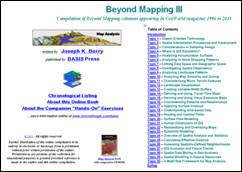
Beyond
Mapping III: A Compilation of Beyond Mapping Columns …is an online book
organizing the Beyond Mapping columns first published in GIS World/GeoWorld from 1996 to 2013
into 28 Topics, Introduction and Epilog. |
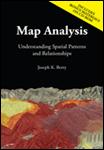
Map
Analysis: Understanding
Spatial Patterns and Relationships …is a hardcopy book (GeoTec
Media, 2007) of selected columns from 1996 to 2007 organized into 10 Topics,
Introduction, Epilog, Index and a companion CD-ROM containing Additional
Readings, Color Graphics files, Instructor Materials and software for
hands-on exercises cross-referenced to the topics. |

Note: click on the
hyperlinks below to access the columns compiled into the Beyond Mapping III
online book.
|
|
…BM columns below were published in
the Map Analysis book/CD (September 1996 to January, 2007). |
||
|
1 |
January
|
2007 |
A
Multifaceted GIS Community — investigates the technical shifts
and cultural impacts of the rapidly expanding GIS tent of users, application
developers and tool programmers |
|
12 |
December
|
2006 |
Pathways
to GIS — explores different paths of GIS adoption for five
disciplines (Natural Resources, Facilities Management, Public Health,
Business and Precision Agriculture) |
|
11 |
November
|
2006 |
Contemporary
GIS and Future Directions — discusses contemporary GIS and
probable future directions (Multimedia Mapping and Spatial Reasoning/Dialog) |
|
10 |
October
|
2006 |
Early
GIS Technology and Its Expression — traces the early phases of
GIS technology (Computer Mapping, Spatial Database Management and Map Analysis/Modeling) |
|
9 |
September
|
2006 |
Statistically
Compare Continuous Map Surfaces — discusses procedures
for comparing continuous map surfaces |
|
8 |
August
|
2006 |
Spatial
Data Mining “Down on the Farm” — discusses process for moving from Whole-Field to Site-Specific management |
|
7 |
July
|
2006 |
Statistically
Compare Discrete Maps — discusses procedures for comparing
discrete maps |
|
6 |
June |
2006 |
Under
the Hood of Spatial Interpolation — investigates
the basic concepts in IDW and Kriging interpolation procedures |
|
5 |
May
|
2006 |
The
Average Is Hardly Anywhere — discusses the
difference between spatial and non-spatial data distributions |
|
4 |
April
|
2006 |
Key
Concepts Characterize Unique Conditions — describes
a technique for handling unique combinations of map layers |
|
3 |
March
|
2006 |
Use
LCP Procedures to Center Optimal Paths — discusses a procedure
for eliminating “zig-zags” in areas of minimal
siting preference |
|
2 |
February
|
2006 |
Nearby
Things Are More Alike — use of decay functions in
weight-averaging surrounding conditions |
|
1 |
January
|
2006 |
Spatially
Aggregated Reporting: The Probability is Good — discusses
techniques for smoothing “salt and pepper” results and deriving probability
surfaces from aggregated incident records |
|
12 |
December
|
2005 |
Filtering
for the Good Stuff — investigates a couple of spatial filters for
assessing neighborhood connectivity and variability |
|
11 |
November
|
2005 |
Milking
Spatial Context Information — describes a procedure for deriving a
customer density surface |
|
10 |
October
|
2005 |
Computer
Processing Aids Spatial Neighborhood Analysis — discusses approaches
for calculating slope and profile |
|
9 |
September
|
2005 |
Connect
All the Dots to Find Optimal Paths — describes a procedure
for determining an optimal path network from a dispersed set of end points |
|
8 |
August
|
2005 |
Taking
Distance to the Edge — discusses advance distance operations |
|
7 |
July
|
2005 |
Calculate
and Compare to Find Effective Proximity — describes how effective
proximity is calculated |
|
6 |
June
|
2005 |
Extend
Simple Proximity to Effective Movement — discusses
the concept of effective distance responding to relative and absolute
barriers |
|
5 |
May
|
2005 |
Use
Cells and Rings to Calculate Simple Proximity — describes how
simple proximity is calculated |
|
4 |
April
|
2005 |
Measuring
Distance Is Neither Here nor There — discusses the basic concepts
of distance and proximity |
|
3 |
March
|
2005 |
Making
Space for Mapped Data — investigates the link between geographic
space and data space for mapping data patterns |
|
2 |
February
|
2005 |
Use
Spatial Statistics to Map Abnormal Averages — discusses surface
modeling to characterize the spatial distribution inherent in a data set |
|
1 |
January
|
2005 |
Bending
Our Understanding of Distance — uses effective distance in
establishing erosion setback to demonstrate spatial analysis |
|
12 |
December
|
2004 |
Moving
Mapping to Analysis of Mapped Data — describes Spatial Analysis
and Spatial Statistics as extensions to traditional mapping and statistics |
|
11 |
November
|
2004 |
’Straightening’
Conversions Improve Optimal Paths — discusses a procedure
for spatially responsive straightening of optimal paths |
|
10.1 |
October
|
2004 |
Logic
and Extent Elevate Suitability Models to New Levels — extends
Rating discussion to include additional habitat considerations and model
weighting |
|
10 |
October |
2004 |
Extended
Experience Materials (unpublished support material) — provides
hands-on experience with Suitability Modeling |
|
9 |
September
|
2004 |
Use
“Shadow Maps” to Understand Overlay Errors — describes
how shadow maps of certainty can be used to estimate error and its
propagation |
|
8 |
August
|
2004 |
Mapping
Techniques Rate Hugag Habitat Suitability — expands
discussion to Binary Progression and Rating suitability models |
|
7 |
July
|
2004 |
Suitability
Models Find the Good, the Bad and the Hugag — describes a simple
suitability model for characterizing habitat |
|
6 |
June
|
2004 |
Computers
Quickly Characterize Spatial Coincidence — discusses
several human considerations in implementing |
|
5 |
May
|
2004 |
Overlay
Operations Feature a Variety of Options — discusses
the basic overlaying map operations |
|
4 |
April
|
2004 |
Options
Seem Endless When Reclassifying Maps — discusses the basic
reclassifying map operations |
|
3 |
March
|
2004 |
Use
a Map-ematical Framework for GIS Modeling — describes
a conceptual structure for map analysis operations and GIS modeling |
|
2 |
February
|
2004 |
Migration
Modeling Determines Spill Effect — describes procedures
for assessing overland and channel flow impacts |
|
1 |
January
|
2004 |
Use
Available Tools to Calculate Flow Time and Quantity — discusses
procedures for tracking flow time and quantity |
|
12 |
December
|
2003 |
Constructing
Realistic Downhill Flows Proves Difficult — discusses
procedures for characterizing path, sheet, horizontal and fill flows |
|
11 |
November
|
2003 |
Traditional
Approaches Can’t Characterize Overland Flow — describes
the basic considerations in overland flow |
|
10.3 |
October
|
2003 |
Think
with Maps to Evaluate Alternative Routes — describes
procedures for comparing routes |
|
10.2 |
October |
2003 |
Least
Cost Path Review (unpublished support material) — brief review of the |
|
10.1 |
October |
2003 |
Extended
Experience Materials (unpublished
support material) — provides
hands-on experience with Optimal Path analysis |
|
9 |
September
|
2003 |
A
Recipe for Calibrating and Weighting GIS Model Criteria — identifies
procedures for calibrating and weighting map layers in GIS models |
|
8 |
August
|
2003 |
Consider
Multi-Criteria When Routing — discusses
the construction of a discrete “cost/avoidance” map and optimal path
corridors |
|
7 |
July
|
2003 |
A
Three-Step Process Identifies Preferred Routes — describes
the basic steps in Least Cost Path analysis |
|
6 |
June
|
2003 |
Use
Mapping “Art” to Visualize Values — describes procedures
for generating contour maps |
|
5 |
May
|
2003 |
Turning
GIS Education on Its Head — describes the
numerous GIS career pathways and the need to engage prospective students from
a variety of fields |
|
4 |
April
|
2003 |
Multiple
Methods Help Organize Raster Data — discusses different
approaches to storing raster data |
|
3 |
March
|
2003 |
Try
Vulnerability Maps to Visualize Aesthetics — describes
a procedure for deriving an aesthetics map based on visual exposure to pretty
and ugly places |
|
2 |
February
|
2003 |
Use
Maps to Assess Visual Vulnerability — discusses a procedure
for identifying visually vulnerable areas |
|
1 |
January
|
2003 |
Beware
of Slope’s Slippery Slope — describes various
slope calculations and compares results |
|
12 |
December
|
2002 |
Use
Surface Area for Realistic Calculations — describes
a technique for adjusting planimetric area to surface area considering
terrain slope |
|
11 |
November
|
2002 |
Identify
Valley Bottoms in Mountainous Terrain — illustrates
a technique for identifying flat areas connected to streams |
|
10 |
October
|
2002 |
Accumulation
Surfaces Connect Bus Riders and Stops — discusses an accumulation surface
analysis procedure for linking riders with bus stops |
|
9 |
September
|
2002 |
Normalizing
Maps for Data Analysis — describes map normalization and data
exchange with other software packages |
|
8 |
August
|
2002 |
Maps
Are Numbers First, Pictures Later — discusses the numeric
and geographic characteristics of map values |
|
7 |
July
|
2002 |
Grids
and Lattices Build Visualizations — describes Lattice and
Grid forms of map surface display |
|
6 |
June
|
2002 |
Use
Travel Time to Connect with Customers — describes techniques for optimal path
and catchment analysis |
|
5 |
May
|
2002 |
Grid-Based
Mapping Identifies Customer Pockets and Territories — identifies techniques
for identifying unusually high customer density and for delineating spatially
balanced customer territories |
|
4 |
April
|
2002 |
Maps
and Curves Can Spatially Characterize Customer Loyalty — describes a technique
for characterizing customer sensitivity to travel-time |
|
3 |
March
|
2002 |
Use Travel Time to Identify Competition
Zones — discusses the procedure for deriving relative travel-time
advantage maps |
|
2 |
February
|
2002 |
Stratify
Maps to Make Better Predictions — illustrates a procedure for
subdividing an area into smaller more homogenous groups prior to generating
prediction equations |
|
1 |
January
|
2002 |
Spatial
Data Mining Allows Users to Predict Maps — describes the basic concepts and
procedures for deriving equations that can be used to derive prediction maps |
|
12 |
December
|
2001 |
Use
Statistics to Map Data Clusters — discusses clustering for
partitioning an area into separate data groups |
|
11 |
November
|
2001 |
Use
Similarity to Identify Data Zones — describes level-slicing for
classifying areas into zones containing a specified data pattern |
|
10 |
October |
2001 |
Geographic
Software Removes Guesswork from Map Similarity — discusses
basic considerations and procedures for generating similarity maps |
|
9 |
September
|
2001 |
Use
Polar Variograms to Assess Distance and Direction Dependencies —
discuses a procedure to incorporate direction as well as distance for
assessing spatial dependency |
|
8 |
August
|
2001 |
Use
Exposure Maps and Fat Buttons to Assess Visual Impact — investigates
procedures for assessing visual exposure |
|
7 |
July
|
2001 |
Visual
Exposure is in the Eye of the Beholder — describes procedures
for assessing visual impact and creating simple models |
|
6 |
June
|
2001 |
Identify
and Use Visual Exposure to Create Viewshed Maps — discusses
basic considerations and procedures for establishing visual connectivity |
|
5 |
May
|
2001 |
Consider
Slope and Scenic Beauty in Deriving Hiking Maps — describes a general
procedure for weighting friction maps to reflect different objectives |
|
4 |
April
|
2001 |
Derive
and Use Hiking-Time Maps for Off-Road Travel — discusses procedures
for establishing hiking-time buffers responding to off-road travel |
|
3 |
March
|
2001 |
Integrate
Travel-Time into Mapping Packages — describes procedures
for transferring travel-time data to other maps |
|
2 |
February
|
2001 |
Use
Travel-Time Buffers to Map Effective Proximity — discusses
procedures for establishing travel-time buffers responding to street type |
|
1 |
January
|
2001 |
Create
Effective Distance Buffers to Improve Map Accuracy — develops
procedures for creating buffers that respond to the relative ease of
movement |
|
12 |
December
|
2000 |
Line-of-Sight
Buffers Add Intelligent to Maps — describes
procedures for creating buffers that track relative visual exposure and noise
levels |
|
11 |
November
|
2000 |
Extending
GIS Procedures with Variable-Width Buffers — discusses
the basic considerations in establishing variable-width buffers that respond
to both intervening conditions and the type of connectivity |
|
10 |
October
|
2000 |
Video
Mapping Brings Maps to Life — describes how video
maps are generated and discusses some applications of video mapping |
|
9 |
September
|
2000 |
Capture
"Where and When" on Video-based GIS — describes
how |
|
8 |
August
|
2000 |
How
to Represent Changes in a Virtual Forest — discusses
how simulations and "fly-bys" are used to visualize landscape
changes and characteristics |
|
7 |
July
|
2000 |
How
to Rapidly Construct a Virtual Scene — describes
the procedures in generating a virtual scene from landscape inventory
data |
|
6 |
June
|
2000 |
Behind
the Scenes of Virtual Reality — discusses the basic
considerations and concepts in 3D-object rendering |
|
5 |
May
|
2000 |
Modeling Erosion and Sediment Loading
— illustrates a |
|
4 |
April
|
2000 |
Confluence
Maps Further Characterize Micro-terrain Features —
describes the use of optimal path density analysis for mapping surface flows |
|
3 |
March
|
2000 |
Characterizing Terrain Slope and Roughness
— discusses techniques for determining terrain inclination and
coarseness |
|
2 |
February
|
2000 |
Characterizing Local Terrain Conditions
— discusses the use of "roving windows" to distinguish
localized variations |
|
1 |
January
|
2000 |
Use
Data to Characterize Micro-Terrain Features — describes
techniques to identify convex and concave features |
|
12 |
December
|
1999 |
Can
Predictable Maps Work for You? — describes a procedure
for deriving a spatial prediction model |
|
11 |
November
|
1999 |
Use
Scatterplots to Understand Map Correlation — discusses
the underlying concepts in assessing correlation among maps |
|
10 |
October
|
1999 |
Use
Statistics to Compare Map Surfaces
— describes several techniques for comparing map surfaces |
|
9 |
September
|
1999 |
Compare Maps by the Numbers
— describes several techniques for comparing discrete maps |
|
8 |
August
|
1999 |
Use
Metrics to Assess Forest Fragmentation — describes some
landscape indices for determining richness and fragmentation |
|
7 |
July
|
1999 |
Get to the Core of Landscape Analysis
— describes techniques for assessing core area and edge
characterization |
|
6 |
June
|
1999 |
Use
GIS to Analyze Landscape Structure — discusses the
underlying principles in landscape analysis and introduces some example
landscape indices |
|
5 |
May
|
1999 |
Use
GIS to Calculate Nearby Neighbor Statistics — describes
a technique that calculates the proximity to all of the surrounding parcels
of a similar vegetation type |
|
4 |
April
|
1999 |
GIS Represents Spatial Patterns and
Relationships — discusses the
important differences among discrete mapping , continuous map surfaces and
map analysis |
|
3 |
March
|
1999 |
Observe
the Evolving GIS Mindset — illustrates the
"map-ematical" approach to analyzing
mapped data |
|
2 |
February
|
1999 |
Is
GIS Technology Ahead of Science? — discusses
several issues surrounding the differences in the treatment of non-spatial
and spatial data |
|
1 |
January
|
1999 |
Extending Spatial Dependency to Maps
— describes a technique for generating a map of spatial
autocorrelation |
|
12 |
December
|
1998 |
Measuring Spatial Dependency
— describes the basic measures of autocorrelation |
|
11 |
November
|
1998 |
Unlocking
the Keystone Concept of Spatial
Dependency — discusses spatial
dependency and illustrates the effects of different spatial arrangements of
the same set of data |
|
10 |
October
|
1998 |
GIS Data Are Rarely Normal
— describes the basic non-spatial descriptive statistics |
|
9 |
September |
1998 |
GIS Software's Changing Roles
— discusses the evolution of GIS software and identifies
important trends |
|
8 |
August
|
1998 |
Identify Data Patterns — discusses
data clustering and its application in identifying spatial patterns |
|
7 |
July
|
1998 |
Explore Data Space — establishes
the concept of "data space" and how mapped data conforms to this
fundamental view |
|
6 |
June
|
1998 |
Link Data and Geographic Distributions
— describes the direct link between numeric and geographic
distributions |
|
5 |
May
|
1998 |
Beware
the Slippery Surfaces of GIS Modeling — discusses
the relationships among maps, map surfaces and data distributions |
|
4 |
April
|
1998 |
Continued
Analysis of In-Store Movement and Sales Patterns — describes
the use of temporal analysis and coincidence mapping to enhance shopping
patterns |
|
3 |
March
|
1998 |
Further
Analyzing In-Store Movement and Sales Patterns — discusses
how map analysis is used to investigate the relationship between shopper
movement and sales |
|
2 |
February
|
1998 |
GIS
Analyzes In-Store Movement and Sales Patterns — describes
a procedure using accumulation surface analysis to infer shopper movement
from cash register data |
|
1 |
January
|
1998 |
Analyzing
Stepped Accumulation Surfaces
— describes a technique for forcing an optimal path through a
series of points |
|
12 |
December
|
1997 |
Determining Optimal Path Corridors
— describes a technique for determining the set of nth
best paths between two points |
|
11 |
November
|
1997 |
Analyzing Accumulation Surfaces
— describes how two surfaces can be analyzed to determine the
relative travel-time advantages |
|
10 |
October
|
1997 |
Building Accumulation Surfaces
— reviews how proximity analysis and effective distance is used
to construct accumulation surfaces |
|
9 |
September
|
1997 |
Diverse
Student Needs Must Drive GIS Education — identifies
new demands and students that are molding the future of GIS education |
|
8 |
August
|
1997 |
Varied
Applications Drive GIS Perspectives — discusses
how map analysis is enlarging the traditional view of mapping |
|
7 |
July |
1997 |
Uncovering the Mysteries of Spatial
Autocorrelation — describes approaches
used in assessing spatial autocorrelation |
|
6 |
June
|
1997 |
Where
Is GIS Education — describes the broadening appeal of |
|
5 |
May |
1997 |
Depending on the Data — discusses
the fundamental concepts of spatial dependency |
|
4 |
April
|
1997 |
Comparing Map Errors — describes
how normalized maps of error can be used to visualize the differences in
error surfaces |
|
3 |
March |
1997 |
Move Beyond a Map Full of Errors
— discusses a technique for generating a "shadow map"
of error |
|
2 |
February |
1997 |
Justifiable Interpolation
— describes the "Residual Analysis" procedure for
assessing interpolation performance |
|
1 |
January
|
1997 |
Designer Samples — describes
different sampling patterns and their relative advantages |
|
12 |
December |
1996 |
What's the Point? —
discusses the general considerations in point sampling design |
|
11 |
November
|
1996 |
Does Anyone Object? — discusses
some concerns of object-oriented GIS |
|
10 |
October
|
1996 |
Spatial
Objects—the Parse and Parcel of GIS? — discusses database
objects and their map expressions |
|
9 |
September
|
1996 |
What
Is Object-Oriented Technology Anyway? — establishes
the basic concepts in object-oriented technology |
_____________________________________________________________________________________
Return to Top of the
listing
|
Online Book |
Hardcopy
Book |
|
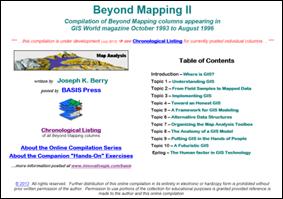
Beyond
Mapping II: A Compilation of
Beyond Mapping Columns …is an online book organizing the Beyond
Mapping columns first published in GIS World (now GeoWorld) from 1993 to 1995 into 10 Topics,
Introduction and Epilog |
Spatial Reasoning for Effective GIS …is a hardcopy book (John Wiley Publishers, 1993) of selected Beyond
Mapping columns organized into 10 Topics, Introduction, Epilog, Resource
Listing, Appendix on GIS Formulae and Index. The BM columns were first published in GIS World (now GeoWorld) from 1993 to
1995 |
Note: click on the
hyperlinks below to access the columns compiled into the Beyond Mapping II
online book at www.innovativegis.com/basis
|
8 |
August
|
1996 |
Developing
an Understanding GIS — describes the translation of mapped
data to spatial information for decision-making |
|
7 |
July
|
1996 |
Don’t
Forget the Human Factor: an Experiential GIS — describes an early
experience (1980) in the application of |
|
6 |
June |
1996 |
Analyzing
Spatial Dependency between Maps — Analyzing Spatial Dependency
Between Maps — investigates multivariate analysis involving the
coincidence of two or more map layers |
|
5 |
May |
1996 |
Analyzing
Spatial Dependency within a Map — investigates univariate analysis involving spatial
relationships within a single map layer |
|
4 |
April |
1996 |
The Unique
Character of Spatial Analysis — discusses spatial analysis
as deriving new spatial information based on geographic dependence within and
among map variables |
|
3 |
March |
1996 |
Classifying
the Analytical Capabilities of GIS — discusses the
differences and similarities in the Berry and Tomlin map analysis
classification schemes |
|
2 |
February |
1996 |
Evaluating
Map-ematical Relationships — discussed the differences and similarities between the
two basic types of GIS models (Cartographic and Spatial) using the Universal
Soil Loss Equation as an example |
|
1 |
January |
1996 |
Extending
Basic Models through Logic Modifications — describes logic extensions to a simple Landslide Susceptible
model by adding additional criteria that changes a model’s structure |
|
12 |
December |
1995 |
From
Recipes to Models — describes basic Binary and Rating model expressions
using a simple Landslide Susceptible model |
|
11 |
November |
1995 |
Heads-Up
and Feet-Down Digitizing — discusses the design components
of a GIS/GPS/RS field unit |
|
10 |
October |
1995 |
GIS
and Remote Sensing Share a Lofty Marriage — identifies the
basic concepts, principles and theoretical underpinnings of Remote Sensing
(RS) technology |
|
9 |
September |
1995 |
Put
Things in Their Proper Places with GPS — identifies
the basic concepts, principles and theoretical underpinnings of the Global
Positioning System (GPS) |
|
8 |
August |
1995 |
Rasterized
Lines and Vectorized Cells —
describes specialized offshoots of
traditional raster and vector data formats |
|
7 |
July |
1995 |
How
are your QUADS and TINS? — describes alternative Quadtree
and Triangular Irregular Network data formats |
|
6 |
June |
1995 |
Raster
is Faster, but Vector is Correcter — describes the structuring of
traditional Vector data using explicit topology linking spatial and attribute
tables |
|
5 |
May |
1995 |
Are
You a GIS Dead Head? — describes the structuring of
traditional Raster data using implicit topology based on the row/column
positioning in a matrix |
|
4 |
April |
1995 |
Explore
a New Spatial Paradigm — discusses the movement from mapping and
spatial inventories by technologists to spatial reasoning and dialog
involving enlightened users in development of solutions to complex spatial
problems |
|
3 |
March |
1995 |
Is
the GIS Cart in Front of the Horse? — discusses driving
forces, trends and forecasts in contemporary GIS from the perspective of
modeling interrelationships among mapped variables |
|
February |
1995 |
Layers
to Tapestry (supplement) — describes an interactive environment
for diagramming GIS Logic and processing flows |
|
|
2 |
February |
1995 |
Dodge
the GIS Modeling Babble Ground — identifies a Classification Guide
for categorizing GIS models |
|
1 |
January |
1995 |
What’s
in a Model? — discusses a conceptual framework for GIS model types and
characteristics |
|
12 |
December |
1994 |
Resolving
Map Detail — discusses
the four basic types Map Resolution (Spatial, Minimum Mapping, Thematic and
Temporal) that define the level of detail in a digital map as dramatically
different from the traditional concept of Map Scale |
|
11 |
November |
1994 |
What
Does Your Computer Really Think of Your Map? — discusses Spatial Topology
through the differences among Graphics Packages, Mapping Software, Spatial
Database Management Systems, and GIS Analysis/Modeling Approaches |
|
10 |
October |
1994 |
Empirical
Verification Assesses Mapping Performance — describes
procedures for assessing mapping performance through Error Matrix (discrete)
and Residual Analysis (continuous) |
|
9 |
September |
1994 |
Avoid
Dis-Information — describes
the calculation of a localized Coefficient of Variance map |
|
8 |
August |
1994 |
Spawning
Uncertainty — identifies a procedure for tracking
error propagation in map overlay |
|
7 |
July |
1994 |
The
This, That, There Rule — describes creating a “Shadow Map of
Certainty” that characterizes the spatial distribution of probable error |
|
6 |
June |
1994 |
Build
It and They Will Come — describes the tactical and
conceptual considerations in GIS implementation |
|
5 |
May |
1994 |
What
Can GIS Do for You? — identifies and discusses the seven
basic types of questions addressed by GIS technology |
|
4 |
April |
1994 |
Question
GIS before You Start — discusses
the importance of an Information Needs Assessment (INA) and a GIS Reality
Assessment (GRA) |
|
3 |
March |
1994 |
Maneuvering
on GIS’s Sticky Floor
— describes Inverse Distance, Kriging, and Minimum Curvature
techniques for surface modeling |
|
2 |
February |
1994 |
Surf’s
Up — fitting
continuous map surfaces to geographic data distributions |
|
1 |
January |
1994 |
Averages
Are Mean — compares
nonspatial and spatial distributions of field data |
|
12 |
December |
1993 |
Consider
a GIS Modeler’s Toolkit
— discusses an Object-Oriented Programming System approach to
GIS model development |
|
11 |
November |
1993 |
Moving
Toward a Humane GIS — describes
an interactive link between GIS model logic and code |
|
10 |
October |
1993 |
Distinguishing
Data from Information and Understanding — considers the
fundamental concepts behind moving mapped data to information and ultimately
to understanding |
_____________________________________________________________________________________
Return to Top of the
listing
|
Online Book |
Hardcopy Book |
|
Beyond
Mapping I: A Compilation
of Beyond Mapping Columns is an online book organizing the Beyond
Mapping columns first published in GIS World (now GeoWorld) from 1989 to
1993 into 10 Topics, Introduction and Epilog. |
Beyond Mapping: Concepts,
Algorithms and Issues in GIS …is a hardcopy
book (John Wiley Publishers, 1993) of selected Beyond Mapping columns
organized into 10 Topics, Introduction, Epilog, Resource Listing, Glossary
and Index. The BM columns were first published in GIS World (now GeoWorld) from 1989 to
1993. |
Note: click on the
hyperlinks below to access individual Beyond Mapping
columns
|
9 |
September |
1993 |
Terminology
Accelerates Your Intellectual Depletion Allowance — introduces
the concepts and organization used in GIS databases comprised of multiple map
layers |
|
8 |
August |
1993 |
GIS
Maps Are Dumb — compares the basic Vector and Raster
data structure approaches for storing individual map layers |
|
7 |
July |
1993 |
Coming
to Terms with Terminology — describes the underlying theory of
how point, line and areal features are stored in Vector and Raster GISs |
|
6 |
June |
1993 |
Special URISA Issue — no BM
column |
|
5 |
May |
1993 |
Is
Conflict Resolution an Oxymoron? — discusses
how weights are used combining individual map layers of concern to derive an
overall map of suitability that reflects group consensus |
|
4 |
April |
1993 |
Maps
Speak Louder than Words — describes
analysis procedures that translate decision-maker concerns into maps |
|
3 |
March |
1993 |
Effective
Standards Required to Go Beyond Mapping — identifies
and describes four levels of GIS standards (data Exchange, Geographic,
Algorithmic and Interpretational) |
|
2 |
February |
1993 |
GIS
Mirrors Perceptions of Decision Criteria
— describes a flowcharting
procedure that expresses GIS model logic in a clear and concise form |
|
1 |
January |
1993 |
Take
a New Look at Visual Connectivity — describes viewshed and visual
exposure procedures |
|
12 |
December |
1992 |
Twists
and Contortions Lead to Connectivity — describes procedures for calculating
optimal paths and routing corridors |
|
11 |
November |
1992 |
Rubber
Rulers Fit Reality Better — describes
procedures for calculating effective distance that considers intervening
absolute and relative barriers |
|
10 |
October |
1992 |
Distance
Is Simple and Straight Forward — describes simple distance calculation as a propagating
wavefront |
|
9 |
September |
1992 |
There’s
More Than One Way to Figure Slope — describes procedures for calculating surface slope and its
varied applications |
|
8 |
August |
1992 |
A
Tailored Plan and Curriculum Cure GIS Training Woes — describes and discusses the
importance of effective education and training needed for successful GIS
adoption |
|
7 |
July |
1992 |
Special URISA Issue — no BM
column but supplemental white paper was made available… Bringing
the GIS Paradigm to Closure — discusses the evolution and
probable future of GIS technology |
|
6 |
June |
1992 |
GIS
Is Never Having to Say You’re Sorry — discusses the human and organizational considerations in
adopting GIS technology |
|
5 |
May |
1992 |
Both
Dreams and Nightmares Are Born of Frustration — discusses the limitations of
traditional cost/benefit analysis in evaluating the adoption of a radically
new technology like GIS |
|
4 |
April |
1992 |
If
I Hadn’t of Believed It, I Wouldn’t Have Seen It — discusses map-wide overlay
techniques and the spatial evaluation of algebraic equations, such as
regression |
|
3 |
March |
1992 |
Map
Overlay Techniques— there’s more than one — discusses
region-wide summary and map coincidence techniques |
|
2 |
Feb/Jan |
1992 |
Characterizing
Spatial Coincidence the Computer’s Way — describes point-by-point overlay
techniques |
|
12 |
December |
1991 |
Analyzing
the Non-Analytical — describes how “joint probability of
coincidence” and “minimum mapping resolution” can be used to assess results
of overlaying maps |
|
11 |
November |
1991 |
GIS
Facilitates Error Assessment — discusses potential sources of error
when overlaying maps and how “shadow maps” of error and “fuzzy theory” can
shed light on the problem |
|
10 |
October |
1991 |
Discovering
Feature Patterns —
describes procedures for assessing landscape pattern (Spacing and Contiguity) |
|
9 |
September |
1991 |
You
Can’t See the Forest for the Trees — discusses indices of feature shape
(Boundary Configuration and Spatial Integrity) |
|
8 |
August |
1991 |
Need
to Ask the Right Questions Takes You Beyond Mapping —
describes indices of map variability (Neighborhood Complexity and Comparison) |
|
7 |
July |
1991 |
Special URISA Issue — no BM
column but supplemental white paper was made available… A
Mathematical Structure for Analyzing Maps— a 1986 journal article
establishing a framework for map analysis/modeling |
|
6 |
June |
1991 |
Frankly
My Dear, I Don’t Give a Damn — discusses how GIS modeling and
spatial reasoning are changing policy formation and decision-making |
|
5 |
May |
1991 |
Who
Says You Can’t Teach an Old Dog New Tricks? — describes
the basic concepts and approaches used in GIS modeling |
|
4 |
Apr/Mar |
1991 |
What’s
Needed to Go Beyond Mapping — lists and describes the analytical tools needed to go beyond
mapping |
|
2 |
Feb/Jan |
1991 |
Technobabble — discusses the radical changes GIS
technology and the digital map are bringing to traditional mapping |
|
12 |
December |
1990 |
I
Don’t Do Windows — describes procedures for summarizing
weighted roving windows |
|
10 |
Oct/Nov |
1990 |
Torture
Numbers, They’ll Tell you Anything — discusses the underlying theory and
basic considerations of spatial interpolation |
|
8 |
Aug/Sep |
1990 |
It’s
Like the New Math, I am Just Too Old — discusses the concept of calculating
a “map derivative” and its use |
|
6 |
Jun/July |
1990 |
Imagination
is More Important than Information — describes procedures for
characterizing surface configuration (slope, aspect and profile) |
|
4 |
Apr/May |
1990 |
There’s
Only One Problem Having All this Sophisticated Equipment — discusses
the basic approaches used for calculating narrowness and visual connectivity |
|
2 |
Feb/Mar |
1990 |
Keep
It Simple Stupid (KISS) — describes the use of “accumulation
surfaces” for deriving optimal path density and Nth best paths |
|
11 |
Nov/Dec |
1989 |
As
the Crow Walks — describes the use of “propagating
waves” for calculating effective distance and optimal paths |
|
9 |
Sep/Oct |
1989 |
You
Can’t Get There from Here — introduces the similarities and
differences between “simple” and “effective” distance measurement |
|
7 |
Jul/Aug |
1989 |
GIS
Technology Is Technical Oz — discusses and compares the relative
advantages/disadvantages between Vector and Raster processing |
|
5 |
May V2-3 |
1989 |
It
Depends: Implications of data structure — discusses
and compares the similarities and differences between Vector and Raster data structure
applications |
|
3 |
March V2-2 |
1989 |
Maps
as Data: a 'Map-ematics' is Emerging
— describes
the differences between Discrete and Continuous mapped data |
|
9 |
Jan V2-1 |
1989 |
No BM column |
|
9 |
Sep V1-2 |
1988 |
No BM column |
|
7 |
Jul V1-1 |
1988 |
No BM column |
_____________________________________________________________________________________
Return to Top of the listing