Posted online at http://www.innovativegis.com/basis/Misc/Geoslavery/
(download .pdf)
Notes
from…
Geoslavery
or Cyber-Liberation: Freedom and Privacy in the Information Age
Bridges
to the Future 2005-2006 Event
Wednesday, September 14, 2005, 7:00-9:00pm
University Of Denver Campus
…prepared by Joseph K. Berry for follow-up
discussion group,
"Geoslavery or Cyber-Liberation: Freedom and Privacy
in the Information Age" —was held on Wednesday, September 14, 2009 in Gates Hall at the Newman Center for the
Performing Arts, 2344 E. Iliff Ave. The
panel featured Professor Jerome E. Dobson from the University of Kansas who is
also President of the American Geographical Society; Professor Stephen Haag,
associate dean of Graduate Programs at the Daniels College of Business who has
expertise in Information Technology; Stephen Keating, business editor at The
Denver Post; and Phillip Zimmerman, creator, Pretty Good Privacy and chairman,
Open PGP Alliance. The panel was
moderated by Prof. Susan Sterett, chair of the Department of Political Science
at DU.
This Forum was part
of the University of Denver’s “Science, Technology and Values” program—what is
the difference between “science” and “technology”? Is the distinction relevant to the issue of
freedom and privacy?—and what is the difference between these concepts?
Dobson made several points
in his opening remarks—
-
Geosalvery
and Cyber-Liberation are not mutually exclusive
-
“Electronic
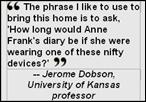
Fence” and “Human Tracking”; imagine Ann Frank with a geo-positioning device
locked to her body
-
Governmental,
Corporate and Private as different levels of “watchers”; citizens, employees, shoppers,
children, spouse, animals and things as different levels of “watched”
-
Positive
tracking as Alzheimer’s patients, backcountry hikers/skiers, goods shipped,
onboard emergency tracking, stolen car, other?
-
Tradeoff
between privacy and freedom; what conditions modify the balance?
-
Haag made several points
in his opening remarks—
-
Cyber-Liberations
contribute to a culture free independence; freely express opinions, level
playing field for dialog (blogs)
-
-
-
E470
electronic toll devices provide ease of travel/convenience but records
date/time/place of travel
-
Must
balance Benefits (Liberate) with Costs (Enslave)
-
Geotechnology
is like accepted previous technology; telephone, automobile, airplane,
etc.
-
Keating made several points
in his opening remarks—
-
Personal
Privacy versus Public Security; call police (security violated) if there was
house break-in not the ACLU (privacy was violated)
-
Police
surveillance cameras require private citizen give up some privacy for some
security
-
“Mice
and Elephants” in my life; depends on the importance of the issue and the
amount of privacy or security that is involve; don’t fret over “mice”
-
Zimmermann made several points
in his opening remarks—
-
Moore’s
Law of technology evolution (computing power for the same price doubles every
18 months) combined with improving and more prevalent surveillance means that
the ability to track with more detail is increasing at an exponential rate
(Capacity)
-
The
ability to fuse and interpret disparate information is increasing at a
exponential rate; geographic position and time are very powerful “universal
codes” that can link databases; WHAT is WHERE and WHEN can couple previously
disparate databases (Capability)
-
Rapidly
developing technology is not guided by policy; opposite is the case (technology
drives policy (forces a reaction from)
-
After
911 it appears that policy is actively utilizing technology; Patriot Act as
long sought set of procedures underwriting increased surveillance (librarians’
objection of privacy rights lost for gain in security); 911 was the catalyst
for civil liberty “turn-back” that had long been sought by law enforcement
-
Technology
can be “used for things we did not intend”
-
Analogy
of submarine (civil liberties) constantly exposed to the relentless pressure of
the sea (erosion of privacy/freedom); mentioned Seinfeld episode of and overdue
library book from 1971 (technology and ability to merge datasets)
1) Moderator
Sterett saw several threads in the opening remarks
for follow-up—
-
What
are some “practical” things that can be done to protect privacy and strike
an appropriate balance between Privacy/Cyber-Liberation and
Security/Surveillance (subclass Geoslavery issue was lost)
-
How do we maintain an appropriate amount of “Wiggle Room”; “right to do the
wrong thing” without harming others (e.g., Stanley vs. Georgia concerned with
illegal pornography in a teenager’s bedroom); Internet (and other electronic
mediums) makes it much easier for surveillance of citizens; loss of wiggle room
Zimmermann response—
-
Most
countries have a privacy commission (Europe, Canada) but corporate opposition
in US
-
Put
a limit on the retention of privacy sensitive records (e.g., phone records
destroyed after bill is paid)
Keating response—
-
Credit
card companies simply pass through losses incurred by identity theft; no
marketplace incentive to strengthen identify theft policies
Haag response—
-
Instilling
core values in children (K-12); respect privacy and take responsibility
-
Recognize
that privacy is a dynamic process and must be thought of as relative so
continually evolving (not an absolute); requires constant policy focus on
identifying new threats created by technology and be in a position to have
policy lead (instead of react) to advancing technological developments
Dobson response—
-
Doesn’t
hear a current groundswell of concern; Roberts hearing focused on “flash”
issues (e.g., abortion) not endemic social issues (e.g., privacy); a public
debate needs to be initiated and be energized enough to get on the public’s and
policy maker’s radar
Zimmermann response—
-
Robert’s
thought there was a right to privacy in the constitution; legal question
if it is an implicit or explicit ‘right”
Dobson response—
-
Difference
between privacy in a private place and privacy in a public place; is there a
right to privacy in a public space …how much?
Zimmermann response—
-
There
is an expectation of privacy; telephone clip[per-chip as backdoor for wire taps
…if implemented then there shouldn’t be an expectation for phone conversation
privacy
-
Triangulation
on gunfire (sound) for positioning and surveillance cameras seem to be
encroaching on the expectation of privacy in a public place
-
As
technology advances it erodes implicit privacy expectations; giving ground with
each unintended (or overt) use of technology for surveillance
2) Moderator Sterett advanced another question of “How
do you think the Internet will be used?” (with respect to the
balance between privacy and security)—
Zimmermann response—
-
noted
Guatemala genocide trial used encryption chips to protect witness identity; globalization
and outsource of jobs; geography barriers are coming down (Thomas book The Flat
Earth)
Keating response—
-
China’s
response to the Privacy/Security balance is the “Great Firewall of China”; we
are one of many nations all striking a different balance (concern for
intellectual property rights radically different in US versus China);
complicates striking a balance in any country
Haag response—
-
education
economic, digital, monetary, health divides are recognized …beginning the
Information Divide; you know about what you know; information is power …rich
vs. poor relative advantages aggravates the divides
Dobson response—
-
not
an “Us vs. Them” issue; top
3) Moderator
Sterett put forward a closing question of “Is technology Opening or
Closing Privacy?” …is it possible it is opening?—
Zimmermann response—
-
encryption
technology used in e-commerce can indirectly be used to increase privacy in computer
dialog; voice over Internet as secure phone conversations (allows encryption)
Keating response—
-
if
everything is known then there is no need for privacy
Zimmermann response—
-
we
now have ability to “see” inside the police station (Rodney King situation); if
encryption is employed then lose ability to track criminal activity for
convictions; is there good/bad privacy flavors? …or is privacy always good?
Haag response—
-
privacy
and Security are not mutually exclusive …comes in a package that balances them
as reflected by social values
Dobson response—
-
to
be geoslavery it must beyond surveillance; involve coercion and control
________________________________

Technology
Trends
Brave new world?
JONATHAN RAPER conjures up Orwellian visions but admits to a professional interest in their realisation
'They are always watching you. Use cash. Do
not give your phone number, social security number or address. Do not fill in
questionnaires. Demand that credit firms remove you from marketing lists. Check
your medical records often. Keep your telephone number unlisted. Never leave
your mobile phone on. Do not use credit or discount cards. If you must use the
Internet, use someone else's computer. Assume that all calls, voice mail, email
and computer use are monitored.'
- The
Economist, 1 May 1999
Like all good parody, this invitation
to paranoia contains an essential truth: privacy is not what it was. In the
information society, we have created a vast new capacity to store personal
details, log transactions, intercept digital communications and engage in video
surveillance. In many cases, the information thus obtained is intended to
facilitate new freedoms, such as online credit purchasing, or to tackle social
problems such as crime.
Faustian pact
While governments regulate this process
through provisions such as data protection legislation, perhaps collectively we
have made a Faustian pact with this information bazaar in the belief that
privacy resides in anonymity. There is a sense that many people regard the
information held on them as reflecting a public persona without
prejudice to their private one - at least, until credit refusals or junk mail
overload spoil the illusion.
Another dimension to this debate will shortly
emerge, this one focussed on the geolocation capabilities of the mobile phone.
Many people already subscribe to cellular tariffs that offer roving 'local'
call rates dependent on one's current location. Mobile phones on this tariff
can be made to display location information (or 'cell info') and which, in many
countries, is the telephone dialing code for the area in which they are
physically located.
Cellular network operators can achieve a
higher level of locational precision by identifying the nearest transmitter
mast to the phone according to signal strength. Generally, these transmitter
cells are several kilometres in area, but shrink to hundreds of metres in city
centres. Locating phones according to their dialling code area is easy but
imprecise. Only occasionally are cellular operators required to forensically
analyse their records to pin-point a mobile 'phone to assist criminal
investigations. However, all this is about to change.
No hiding place
With the arrival of technologies that allow
operators to locate cellular subscribers to within an accuracy of 10-25m has
come the promise of 'location-based services'. It will become possible to
deliver information to you through your phone based on where you are at any
point in time. The 'where' will, in future, place you in a particular building
or on a specific street. With the arrival of larger screens in 'smartphones'
and personal digital assistants (PDA's), and with the delivery of 'always-on'
mobile Internet connectivity, a number of attractive new services will be
offered. A moving map on screen wherever you go; the ability to find nearby
cash machines or petrol stations (that are open and hopefully stocked with fuel
;and the delivery of alerts based on your location- a weather warning if
walking in the mountains, for example. You may, indeed, find the new
information services attractive, but you might also have some concern over
'locational' privacy.
As yet there are few explicit principles to
govern locational privacy. I put a question on this issue to the UK Data
Protection Registrar, Elisabeth France, at the Association for Geographic
Information conference in September 2000. In her response, she said that
personal location held in a computer system was 'personal information' within
the meaning of the 1998 UK Data Protection Act, no matter what the spatial and
temporal resolution.
Caught in the Act?
The gist of this would appear to mean that
anyone merely recording the fact that I am in the UK at any given time on a
computer needs to abide by the principles of the 1998 Act. If I were in another
EU member state, similar provisions exist in EU Directive 95/46/EC. Clearly,
therefore, high resolution geolocation will be governed by data protection
legislation - provided there is consent, a contract, a legal obligation or a
vital/legitimate interest, and you have right of access to the record. However,
'location' is not one of the categories of 'sensitive' information specified in
the 1998 UK Act, i.e., those that govern the processing of data relating to
racial or ethnic origin, political opinions, religious or other beliefs, trade
union membership, health, sex life or criminal convictions.
Perhaps location should be added to this list,
for while there are many potential social and economic benefits to be derived
from location-based services, public support for them may be undermined if constraints
are not seen to be placed on network operators to safeguard locational privacy.
The design of these services and their supporting systems must give users a  measure of control over their own locational profiles;
allow them to delete or generalise those profiles, and set a minimum resolution
or time delay.
measure of control over their own locational profiles;
allow them to delete or generalise those profiles, and set a minimum resolution
or time delay.
Personally, I am hooked, not least as
developer of a location-based service in the EU funded Hypergeo project
(http://www.hypergeo.org/). Here, I have been carrying a prototype device with
JONATHAN RAPER is with the
Department of Information Science, City University, London, England and can be
contacted by email at raper@soi.city.ac.uk
_______________________________
Will
Tracking technology
gives access to dangerous power
CNN,
Tuesday, March 11, 2003 Posted: 10:10 AM EST (1510
LAWRENCE, Kansas (AP) -- Jerome Dobson
worries that 1984 may be just around the corner. Dobson, a University of Kansas
research professor and president of the American Geographical Society, is
concerned that technical advances carry the potential for bringing about George
Orwell's nightmarish vision of a society that destroys privacy. This new
threat, says Dobson -- a respected leader in the field of geographic
information technologies -- is "geoslavery."
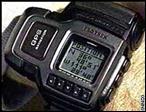 Devices currently on
the market, for example, use satellites to locate and track people anywhere on
the planet.
Devices currently on
the market, for example, use satellites to locate and track people anywhere on
the planet.
One company sells a device that can record a
vehicle's location so employers can keep track of every move their drivers
make.
Sounding an alarm
Another company makes implanted chips to keep
track of livestock or pets, and a device that looks like a digital wristwatch
that can pinpoint the wearer's location and sound an alarm.
Dobson knows the good these devices do, but
he also worries that they may be abused. He hopes his fearful vision will
create debate and perhaps legislation or safeguards around the technology that
will keep it from being misused.
 Already the
technologies are sparking debates regarding privacy. Add a transponder to a
locked device, he said, and the punitive possibilities are endless.
Already the
technologies are sparking debates regarding privacy. Add a transponder to a
locked device, he said, and the punitive possibilities are endless.
"What we are suggesting," Dobson
said, "is that we are only one technological step from placing a transponder
in there that burns or stings a person if they step off a prescribed path by a
meter. Or if they stay too long in one place. Or cross the path of another
person they are prohibited from seeing, or if they congregate with other
people.
"I can confine you to a place. You can't
go there. Or you must go there. And I can control it."
Avoiding abuses
In the hands of repressive governmental
regimes, the devices could be devastating, Dobson said, just as they could be
in people's personal lives.
Before going to Kansas less than two years
ago, Dobson worked 26 years at Tennessee's Oak Ridge National Laboratory
creating, for the government, the maps used in global tracking.
"We may avoid the most serious abuses of
this technology in the U.S. because we have a tradition of personal
freedom," he said. "But it will differ by country and by culture.
Think of the countries where they already have ethnic cleansing."
_______________________________
http://www.ur.ku.edu/News/03N/MarchNews/March5/dobson.html
March 5, 2003
KU
researcher warns against potential threat of 'geoslavery'
LAWRENCE --
Jerome Dobson wants to make sure his field of research doesn't aid the greatest
threat to personal freedom.
As a pioneer of geographic information systems (
Since 1975, Dobson has used
Unfortunately, the same technology that has so many beneficial uses also has
the potential to create a highly sophisticated form of slavery, or
"geoslavery," as Dobson calls it. What worries Dobson is that
"It concerns me that something I thought was wonderful has a downside that
may lead to geoslavery -- the greatest threat to freedom we've ever experienced
in human history," he said.
By combining
Sound like something from a bad sci-fi movie? Actually, several products
currently on the market make this scenario possible.
"In many ways that's what we're doing with prisoners right now, but
they've been through a legal process," he said.
In fact, many of the existing products are marketed to parents as a way to
protect their children from kidnappers. Dobson, however, said parents should
think twice before using such products.
"A lot of people think this is a way to protect their children," he
said. "But most kidnappers won't have any compunction about cutting the
child to remove an implant or bracelet."
Furthermore, these products rely on wireless networks, which are notoriously
easy for hackers to break into, potentially turning the very products meant to
protect children into fodder for tech-savvy child predators.
Dobson outlined the dangers of geoslavery in an article that appears in the
most recent issue of the Institute of Electrical and Electronics Engineers'
Technology and Society magazine. Peter F. Fisher, editor of the International
Journal of Geographic Information Science, co-wrote the paper with Dobson. More
than 375,000 scientists read the IEEE magazine.
One of the greatest dangers of geoslavery is that it doesn't apply just to
governments. For example, individuals could use the technology to perpetuate
various forms of slavery, from child laborers to sex slaves to a simple case of
someone controlling the whereabouts of his or her spouse, Dobson said.
"Many people have concerns today about privacy but they haven't put all
the pieces together and realized this means someone can actually control them
-- not just know about them, but control them," Dobson said.
As the price of these products gets cheaper and cheaper, the likelihood rises
that the technology will be abused, he said. To prevent this, Dobson's paper
outlines a number of actions that should be taken, including revising national
and international laws on incarceration, slavery, stalking and branding, and
developing encryption systems that prevent criminals or countries with bad
human rights records from accessing
Still, the first step is making people aware of the very real threat that
geoslavery poses. The potential for harm is even greater in less developed
nations without strong traditions of personal freedom, he said.
"We need a national dialogue on this if we're going to go into something
so different from our traditional values of privacy and freedom," Dobson
said. "We need to think about it very carefully and decide if this is a
direction we as a society want to go."
Dobson said he doesn't consider himself a crusader. Instead, he is a scientist
who is working diligently to ensure that people really understand the good and
bad sides of the technology he helped create.
"There certainly are many, many good uses for the technology -- that's not
the issue -- the issue is that it can be so easily misused," he said.
"My role as a university professor is to alert people and make sure there
is an informed debate."
____________________
Posted on
 KU professor has nightmare vision of
global positioning technology
KU professor has nightmare vision of
global positioning technology
The Kansas
City Star
The
first thing to know: Jerome Dobson is not joking.
The University of Kansas research professor,
a respected leader in the field of geographic information technologies, thinks
a terrible and unrealized threat looms about the globe.
This new threat, Dobson says, is
"geoslavery" -- a form of technological human control that could make
"George Orwell's `Big Brother' nightmare...look amateurish."
His vision would use the same manner of
electronic devices some parents use to keep track of their children and police
use to restrict the movement of criminals. He's talking about pimps
electronically monitoring their prostitutes. He's talking about overlords
electronically punishing errant workers.
He's talking about the possibility of people
hooked to, tracked by, and potentially shocked or burned using inexpensive
electronic bracelets, manacles or implants under the eyes of global positioning
satellites.
Weird? Perhaps. But it is this scenario that
Dobson is scheduled to present this afternoon in New Orleans at the annual
meeting of the American Association of Geographers.
What gives Dobson's speech heft is his
background. Before going to KU less than two years ago, Dobson worked for 26
years at Tennessee's Oak Ridge National Laboratory creating, for the
government, the maps used in global tracking. He is the president of the
American Geographical Society. And he is not alone in his thoughts.
In the most recent issue of IEEE, the
journal published by the Institute of Electrical and Electronics Engineers, a
paper titled "Geoslavery" is co-written by Dobson and Peter F.
Fisher, British editor of the International Journal of Geographical
Information Science.
"Human tracking systems, currently sold
commercially without restrictions, already empower those who would be masters,
and safeguards have not yet evolved to protect those destined to be
slaves," they wrote.
"I've spoken about this at academic
conferences," Dobson said by phone from New Orleans. "I find that the
first reaction people have is, maybe, disbelief. But if I talk for two minutes,
suddenly they begin to turn somber and say, `This is the scariest thing I have
ever seen.' "
Even those experts who view Dobson's vision
as exaggerated concede that his notions are within the realm of reality.
"Technically, it is possible," said
Glen Gibbons, editor of
To Dobson, the point is to address the threat
before it is too late.
Numerous companies produce devices that,
using satellites, are able to locate and track people anywhere on the planet:
-
Advanced
Tracking Technologies Inc. of Houston sells TravelEyes. Placed in a vehicle,
the device records a driver's location every moment of the day. It records how
long the driver has stopped, the path a vehicle has taken, the speed traveled.
With a laptop computer, employers can keep track of their drivers' every move.
-
Digital
Angel Corp. of St. Paul, Minn., makes implanted chips to keep track of
livestock or pets. It also sells a Personal Safety and Location System. The
device looks like a digital wristwatch. When the wearer -- say an elderly
person with Alzheimer's -- wanders, the device not only pinpoints the person's
location, but also sounds an alarm. The devices have emergency buttons that
call 911 if a person has fallen or has a drastic change in temperature.
-
In
Redwood Shores, Calif., a company called Whereify Wireless Inc. sells its
Dobson said that in creating these products,
none of the companies was thinking of anything nefarious. He absolutely knows
the good they do.
Like
all the electronic monitoring devices, Whereify comes with 911 alert and
locator features that can be triggered in case of an emergency. It even can be
triggered automatically if someone tries to remove the device from a child's
wrist.
___________________________
Based on lecture notes by
Michael Goodchild, USSB, Geography
http://www.geog.ucsb.edu/~good/176b/n14.html
SOCIAL ISSUES Surrounding
Geotechnology
Do we have a right to location privacy?
Who has the right to know where we are?
Do we have a right to sell our location privacy? …in return for store
discounts?
US law: E911 calls from
cell phones; Wireless Communication and Public Safety Act of 1999…
-
``(4)
to provide call location information concerning the user of a commercial mobile
service (as such term is defined in section 332(d))_
-
``(A)
to a public safety answering point, emergency medical service provider or
emergency dispatch provider, public safety, fire service, or law enforcement
official, or hospital emergency or trauma care facility, in order to respond to
the user's call for emergency services;
-
``(B)
to inform the user's legal guardian or members of the user's immediate family
of the user's location in an emergency situation that involves the risk of
death or serious physical harm; or
-
``(C)
to providers of information or database management services solely for purposes
of assisting in the delivery of emergency services in response to an
emergency.''.
UK law: Telecommunications
(Data Protection and Privacy) Regulations 1999 establishes limitations on the
processing of traffic and billing data by carriers (no clear reference to
location).
Regulation
of Investigatory Powers Act 2001 can require recovery of location known from
mobile phones (when this is part of traffic data) for intelligence purposes.
Is
there adequate regulatory protection for the use of location in traffic data?
Who
has access to the location?
How long should it be kept?
What geographic resolution is available?
Do
users have control over their location information?
What
is privacy? …relates to individuals; guards against intrusion, appropriation,
breach of confidence
Economist
1 May 1999—"They are always watching
you. Use cash. Do not give your phone number, social security
number or address. Do not fill in questionnaires. Demand that
credit firms remove you from marketing lists. Check your medical records
often. Keep your telephone number unlisted. Never leave your mobile
phone on. Do not use credit or discount cards. If you must use the
Internet, use someone else’s computer. Assume that all calls, voice mail,
email and computer use are monitored."
Location
privacy:
-
Protection
of information about your current or home location in space or cyberspace;
currently no explicit regulation of locational privacy
-
Raper
essay in
January 2001 GeoEurope http://www.geoplace.com/ge/2001/0101/0101tt.asp
-
Private
persona - should be absolutely protected
-
Public
persona - tradable by consent, disconnected from the private persona
_________________________________