|
|
…an introduction to grid-based map analysis and
modeling GEOG 3110,
University of Denver, Geography, Winter Term 2013 Thursdays
6:00-9:15 pm, <Click
here >for a printer-friendly version of this Syllabus <Click here>
for 1-page flyer describing the course |

<Class
website is posted at http://www.innovativegis.com/basis/Courses/GMcourse13/>
<This Syllabus is posted at http://www.innovativegis.com/basis/Courses/GMcourse13/Syllabus/>
Instructor: Joseph
K. Berry, Room 213 Boettcher West, phone 970-215-0825
 About the instructor: http://www.innovativegis.com/basis/basis/cv_berry.htm
Email: jkberry@du.edu
or jberry@innovativegis.com – Website: www.innovativegis.com/basis
Open Door office hours are Thursdays, 3:00 to
5:00pm (or specially arranged
on Thursdays)
Course Materials:
-
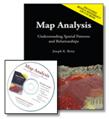
Course Text is Map Analysis: Understanding Spatial Patterns and Relationships
(Berry, 2007) available at an author’s
discount at the first class meeting ($34.64) or you can order from www.geoplace.com/books/mapanalysis
for $51.95, includes U.S
shipping. The book includes a Companion CD including software Further Readings, Example Applications,
Software and Exercises…
http://www.innovativegis.com/basis/Books/MapAnalysis/
-
Course Materials including lecture notes, exercises
and readings are posted on the Class Website at…
http://www.innovativegis.com/basis/Courses/GMcourse13/
Course Description:
|
|
|
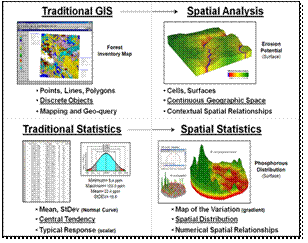
This
intermediate course focuses on the concepts and procedures used in discovering
and applying the spatial relationships within and among maps. It extends the mapping and geo-query
capabilities of
Topics
include the Nature of Mapped Data,
Spatial Analysis and
The course
uses Dr. Berry’s book Map
Analysis: Understanding Spatial
Patterns and Relationships (GeoTec Media,
2007).
See www.innovativegis.com/basis/Books/MapAnalysis/
for more information about the book
Application
areas addressed in the course include Natural Resources (Habitat Mapping, Wildfire Risk, Visual
Exposure Impacts, Accessibility), Precision Agriculture (Soil Nutrient Mapping, Yield Analysis,
Fertility Program Optimization, Erosion Potential), Infrastructure (Routing and Optimal Paths, Risk Analysis,
Consensus Building), Geo-Business (Store Siting, Competition Analysis, Retail sales Forecasting,
Commercial Properties Investment) and numerous other examples that draw on
the instructor’s consulting, presentations and research projects.
Course Objectives:
Students will
develop spatial reasoning skills necessary in conceptualizing, flowcharting and
implementing
ü an understanding of the differences
between data processing in discrete and continuous space
ü an awareness of spatial dependency
within and among mapped data and its effect on map analysis
ü a working knowledge of basic spatial
interpolation and statistics procedures
ü a working knowledge of grid-based
spatial analysis operations to include visual analysis, effective distance,
optimal path density, terrain analysis, contextual summaries and
edge/shape/pattern characterization, and
ü an ability to conceptualize, flowchart
and implement
Topics and Schedule:
|
Week |
Topic |
|
1 1/10 |
Overview: URL links to Reading Assignment are posted on the Class Website at… http://www.innovativegis.com/basis/Courses/GMcourse13/
Map Analysis book sections — Foreword, Preface, Introduction and Table of Contents Online Papers — “Making a Case for SpatialSTEM”
and “An Analytical Framework for GIS Modeling” |
|
2 1/17 |
Maps as Data: Map
data types and their implications; Contouring and thematic mapping
effects/implications; Vector vs. Raster; Raster images, grids and
pseudo-grids |
|
3 1/24 |
Reclassifying and Overlaying Data Layers: Characterizing size, shape, pattern and
arrangement; Point, region and map-wide overlay; Grid math; Spatial coincidence
statistics; Comparing maps; Error propagation |
|
4 1/31 |
Measuring Distance and Connectivity: Simple vs. effective distance; Proximity
and movement; Accumulation surfaces; Identifying optimal path(s); Viewsheds and visual exposure surfaces; Narrowness
surfaces |
|
5 2/7 |
Summarizing Spatial Context: Calculating slope, aspect and profile maps;
Applying spatial differentiation and integration; Roving window summary
operations; Characterizing edges and complexity |
|
6 2/14 |
***
online Exam #1 — covers week 1-5 material *** |
|
7 2/21 |
GIS Modeling Examples: Pipeline routing; Wildfire risk mapping;
Micro-terrain analysis; Retail sales prediction |
|
8 2/28 |
Surface Modeling: Basic statistics and its |
|
9 3/7 |
Spatial Data Mining: Linking numeric and geographic patterns; Normalizing maps; Viewing scatter plots; Clustering mapped data;
Investigating map correlation; Developing prediction models; Assessing
prediction results |
|
10 3/14 |
Future Directions: Dynamic
map pedigree; Toward a humane |
|
Finals Week |
***
online Exam #2 — covers weeks 6-10 material *** *** Grad
Student Presentations during scheduled Final Exam period *** |
Prerequisites:
An
introductory course in
Course Format:
The class
meets once a week for three hours with a 15 minute midway break. Class meetings involve lecture, discussion
and real-time demonstrations of concepts in spatial analysis, spatial
statistics and
Guidelines for Preparing Homework
Assignments
Homework/lab
assignments use course software to address a series of questions that
demonstrate
The
homework/lab and mini-project assignments will be completed in two to four
member teams. To help keep track,
please name your homework files with the exercise number followed by the team
member names separated by an underscore (e.g., Exercise0_Berry_Smith_Jones.doc).
The extension “_graded” will be added when the assignment is graded and
returned to each of the members on the team.
The homework/lab exercises represent over
half of your grade (7 Lab reports plus 1 Project report = 350 + 150= 500 of 900
total points). One of the seven weekly
homework/lab reports can be skipped (student discretion; grade will be
determined as the overall average of other homework exercises). Students can choose to substitute an
individual report (10-15 pages) on any GIS modeling related topic of their
choice for either of the last two lab reports.
In addition
to normal course requirements of participation, homework/lab reports,
mini-project and exams, graduate
students are required to submit a short paper and oral presentation on
how they believe they will use the material learned in this course in their
academic research (thesis students) or anticipated professional work
environment (non-thesis students). The
paper and presentation are due during the scheduled Final Exam period for the
course.
Submitting Homework Assignments
Homework
assignments are due by 12:00 midnight the following Thursday night
(7 days to complete). This provides an
opportunity to address questions via email and during the instructor’s office
hours. If more time is needed, email a
request for an extension before class
specifying a new due date/time.
Submission and Grading:
Store your completed exercises as Word documents (.doc
file) and email the group’s report directly to me (jberry@innovative.com). All exchange of the labs will be in
electronic Web Layout View
format. The document will returned the
following week with grading comments, team evaluation and overall grade.
Method of Evaluation:
Grades for
the course will be determined as follows:
|
Undergraduate Students |
Graduate Students |
|
|
Teammate Evaluations (7 labs * 10 points + 1 mini-project of 30 points) |
100 |
100 |
|
Homework Exercises (7 assignments worth 50 points each) |
350 |
350 |
|
|
150 |
150 |
|
Exam 1 (taken online during Week 6) |
150 |
150 |
|
Exam 2 (taken online during Finals week) |
150 |
150 |
|
Graduate Student Paper and
Presentation (scheduled Final
Exam period) |
-- |
100 |
|
Total Points |
900 |
1000 |
Note: Up to 100 Optional/Extra Credit Points are available for
students wanting to pursue a topic in greater detail or increase their
grade. Points earned are cumulative and
translate into a letter grade according to the following scale:
A+ 97-100%, A 93-97%, A- 90-93%, B+ 87-90%, B 83-87%, B- 80-83%, C+ 77-80%,
C 73-77%, C- 70-73%, D+ 67-70%, D 63-67%, D- 60-63%, F 0-60% (tie point goes to the student)
Students are expected to attend class regularly. Class lectures, discussion and demonstrations
are an important part of the course that is difficult to reconstruct. Excused absences include illness, death in
the family or participation in a DU sanctioned event. If you must miss class, please notify the
instructor prior to the
class meeting so arrangements for makeup of the material missed can be
made.
Unexcused late homework assignments without prior
notification receive a maximum possible of 45 points (10% penalty) if turned in
before to the next class meeting and will not be accepted (0 points) if more
than one week late. There are no make-up
exams except for excused absences with prior notification. Students may review their current grade at
anytime during office hours; periodic summaries will be emailed.
Course
Software
All of the course
software is installed on the GIS Lab computers.
You can install the software to your own computer from the Map
Analysis book’s companion CD or download from the Internet—
 Microsoft
Office [you need to have working
versions of Microsoft Office applications Word,
PowerPoint and Excel loaded on your computer]
Microsoft
Office [you need to have working
versions of Microsoft Office applications Word,
PowerPoint and Excel loaded on your computer]
 Adobe
Reader [download
and install from the Internet — Windows-based program for viewing/printing documentation
files (.pdf); free software; see www.adobe.com/products/acrobat/readstep2.html
for more
information on Adobe Reader and free download]
Adobe
Reader [download
and install from the Internet — Windows-based program for viewing/printing documentation
files (.pdf); free software; see www.adobe.com/products/acrobat/readstep2.html
for more
information on Adobe Reader and free download]
 SnagIt [download and install from the Internet — screen capture software; 30 day
evaluation; see www.techsmith.com/ for information on fully licensed
system ($37.95 Academic
version)]
SnagIt [download and install from the Internet — screen capture software; 30 day
evaluation; see www.techsmith.com/ for information on fully licensed
system ($37.95 Academic
version)]
 MapCalc Learner [install from
the Map Analysis book Companion CD or
download from www.innovativegis.com — grid-based map analysis software
included with the course
materials provided by the instructor]
MapCalc Learner [install from
the Map Analysis book Companion CD or
download from www.innovativegis.com — grid-based map analysis software
included with the course
materials provided by the instructor]
 Surfer Demo [install the demo Version 8 software from the Map Analysis book Companion CD — surface modeling and 3D display software included
with the course materials
provided by the instructor; also you can download the most recent version from www.goldensoftware.com/demo.shtml
but the exercises in the
course may not directly correspond; see www.goldensoftware.com and select “Productsà Surfer” for more information on fully
licensed system ($699)]
Surfer Demo [install the demo Version 8 software from the Map Analysis book Companion CD — surface modeling and 3D display software included
with the course materials
provided by the instructor; also you can download the most recent version from www.goldensoftware.com/demo.shtml
but the exercises in the
course may not directly correspond; see www.goldensoftware.com and select “Productsà Surfer” for more information on fully
licensed system ($699)]
___________________________