Part 1 –
Understanding Effective Distance Concepts
Note:
These topics appeared in GIS World, Vol. 2, No.5 through Vol. 3, No. 2,
September 1989 to May 1990. Also they
serve as the basis for portions of Topic 2, Sections 4-6 in Beyond Mapping:
Concepts, Algorithms, and Issues in GIS (Berry, 1993; Wiley)
YOU CAN'T GET THERE FROM HERE...
Measuring
distance is one of the most basic map analysis techniques. However, the effective integration of
distance considerations in spatial decisions has been limited. Historically, distance is defined as 'the shortest
straight-line distance between two points'.
While this measure is both easily conceptualized and implemented with a
ruler, it is frequently insufficient for decision-making. A straight line route may indicate the
distance 'as the crow flies', but offer little information for the walking crow
or other flightless creature. It is
equally important to most travelers to have the measurement of distance
expressed in more relevant terms, such as time or cost.
Consider
the trip to the airport from your hotel.
You could take a ruler and measure the map distance, then use the map
scale to compute the length of a straight-line route-- say twelve miles. But you if intend to travel by car it is
likely longer. So you use a sheet of
paper to form a series of 'tick marks' along its edge following the zigs and
zags of a prominent road route. The
total length of the marks multiplied times the map scale is the non-straight
distance-- say eighteen miles. But your
real concern is when shall I leave to catch the nine o'clock plane, and what
route is the best? Chances are you will
disregard both distance measurements and phone the bellhop for advice-- twenty
four miles by his back-road route, but you will save ten minutes. Most
decision-making involving distance follows this scenario of casting aside the
map analysis tool and relying on experience.
This procedure is effective as long as your experience set is robust and
the question is not too complex.
The
limitation of a map analysis approach is not so much in the concept of distance
measurement, but in its implementation.
Any measurement system requires two components-- a standard unit
and a procedure for measurement.
Using a ruler, the 'unit' is the smallest hatching along its edge and
the 'procedure' is shortest line along the straight-edge. In effect, the ruler represents just one row
of a grid implied to cover the entire map.
You just position the grid such that it aligns with the two points you
want measured and count the squares. To
measure another distance you merely realign the grid and count again.
The
approach used by most GIS's has a similar foundation. The unit is termed a grid space implied by superimposing
an imaginary grid over an area, just as the ruler implied such a grid. The procedure for measuring distance from
any location to another involves counting the number of intervening grid spaces
and multiplying by the map scale-- termed shortest straight-line. However, the procedure is different as the
grid is fixed so it is not always as easy as counting spaces along a row. Any point-to-point distance in the grid can
be calculated as the hypotenuse of a right triangle formed by the grid's rows
and columns. Yet, this even procedure
is often too limited in both its computer implementation and information
content.
Computers
detest computing squares and square roots.
As the Pythagorean theorem, just noted, is full of them most GIS use
another procedure-- 'proximity'. Rather
than sequentially computing the distance between pairs of locations, concentric
equidistance zones are established around a location or set of locations. This procedure is analogous to nailing one
end of a ruler at one point and spinning it around. The result is similar to the wave pattern generated when a rock is
thrown into a still pond. Each ring
indicates one 'unit farther away'-- increasing distance as the wave moves
away. A more complex proximity map
would be generated if, for example, all locations with houses are
simultaneously considered target locations; in effect, throwing a handful of
rocks into the pond. Each ring grows
until wave fronts meet, then they stop.
The result is a map indicating the shortest straight-line distance to
the nearest target area (house) for each non-target area.
In
many applications, however, the shortest route between two locations may not
always be a straight-line, And even if
it is straight, its geographic length may not always reflect a meaningful
measure of distance. Rather, distance
in these applications is best defined in terms of 'movement' expressed as
travel-time, cost or energy that may be consumed at rates which vary over time
and space. Distance modifying effects
are termed barriers, a concept implying the ease of movement in space is
not always constant. A shortest route
respecting these barriers may be a twisted path around and through the
barriers. The GIS data base allows the
user to locate and calibrate the barriers.
The GIS wave-like analytic procedure allows the computer to keep track
of the complex interactions of the waves and the barriers.
Two
types of barriers are identified by their effects-- absolute and relative. 'Absolute barriers' are those completely
restricting movement and therefore imply an infinite distance between the
points they separate. A river might be
regarded as an absolute barrier to a non-swimmer. To a swimmer or a boater, however, the same river might be
regarded as a relative barrier.
'Relative barriers' are those that are passable, but only at a cost
which may be equated with an increase in geographical distance-- it takes five
times longer to row a hundred meters than to walk that same distance. In the conceptual framework of tossing a
rock into a pond, the waves crash and dissipate against a jetty extending into
the pond-- an absolute barrier the waves must circumvent to get to the other
side of the jetty. An oil slick
characterizes a relative barrier-- waves may proceed through, but at a reduced
wavelength (higher cost of movement over the same grid space). The waves will proceed both around and
through the oil slick; the one reaching the other side identifies the
'shortest, not necessarily straight line'.
In effect this is what lead to the bellhops 'wisdom'-- he tried many routes
under various conditions to construct his experience base. In GIS, this same approach is used, yet the
computer is used to simulate these varied paths.
In
using a GIS to measure distance, our limited concept of 'shortest straight-line
between two points' is first expanded to one of proximity, then to a more
effective one of movement through a realistic space containing various
barriers. In the past our only recourse
for effective distance measurement in 'real' space was experience-- 'you can't
get there from here, unless you go straight through them thar mountains'. But deep in your visceral you know there has
to be a better way.
AS THE CROW WALKS...
…Traditional mapping is in triage. We need to discard some of the old ineffective procedures and apply new life-giving technology to others. (JKB)
Last
issue's discussion of distance measurement with a GIS challenged our
fundamental definition of distance as 'the shortest straight line between two
points.' It left intact the concept of
'shortest', but relaxed the assumptions that it involves only 'two points' and
has be 'straight'. In so doing, it
first expanded the concept of distance
to one of proximity-- shortest, straight line from a location, or set of locations,
to all other locations. Such as a
'proximity to housing' map indicating the distance to the nearest house for
every location in a project area.
Proximity was then expanded to the concept of movement by introducing
barriers-- shortest, but necessarily a straight. Such as a 'weighted proximity to housing' map recognizing various road and water conditions effect on the
movement of some creatures (flightless, non-swimming crawlers-- like us when
the car is in the shop).
Basic
to this expanded view of distance is conceptualizing the measurement process as
waves radiating from a location(s)-- analogous to the ripples caused by tossing
a rock in a pond. As the wave-front
moves through space, it first checks to see if a potential 'step' is passable
(absolute barrier locations are not). If so, it moves there and incurs the
'cost' of such a movement (relative barrier weights of impedance). As the wave-front proceeds, all possible
paths are considered and the shortest distance assigned (least total impedance
from the starting point). It's similar
to a macho guy swaggering across a rain-soaked parking lot as fast as
possible. Each time a puddle is
encountered a decision must be reached-- slowly go through so as not to slip,
or continue a swift, macho pace around.
This distance-related question is answered by experience, not detailed
analysis. "Of all the puddles I
have encountered in my life", he muddles, "this looks like one I can
handle." A GIS will approach the
question in a much more methodical manner.
As the distance wave-front confronts the puddle, it effectively splits
with one wave proceeding through at a slower rate and one going around at a
faster rate. Whichever wave gets to the
other side first determines the 'shortest distance'; whether straight or not. The losing wave-front is then totally
forgotten and no longer considered in subsequent distance measurements.
As
the wave-front moves through space it is effectively evaluating all possible
paths, retaining only the shortest. You
can 'calibrate' a road map such that off-road
areas reflect absolute barriers and different types of roads identify relative
ease of movement. Then start the
computer at a location asking it move outward with respect to this complex
friction map. The result is a map
indicating the travel-time from the start to everywhere along the road network--
shortest time. Or, identify a set of
starting points, say a town's four fire houses, and have them simultaneously
move outward until their wave-fronts meet.
The result is a map of travel-time to the nearest fire house for every
location along the road network. But
such effective distance measurement is not restricted to line networks. Take it a step further by calibrating off-road
travel in terms of four-wheel 'pumper truck' capabilities based on land cover
and terrain conditions-- gently sloping meadows fastest; steep forests much
slower; and large streams and cliffs, prohibitive (infinitely long time). Identify a forest district's fire
headquarters, then move outward respecting both on- and off-road movement for a
fire response surface. The resulting
surface indicates the expected time of arrival to a fire anywhere in the
district.
The
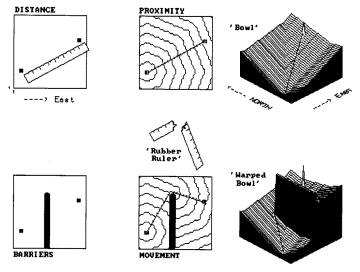
idea of a 'surface' is basic in understanding both weighted distance
computation and application. The top
portion of the accompanying figure develops this concept for a simple proximity
surface. The 'tic marks' along the
ruler identify equal geographic steps from one point to another. If it were replaced with a drafting compass
with its point stuck at the lower left, a series of concentric rings could be
drawn at each ruler tic mark. This is
effectively what the computer generates by sending out a wave-front through
unimpeded space. The less than perfect
circles in the middle inset of the figure are the result of the relatively
coarse analysis grid used and approximating errors of the algorithm-- good
estimates of distance, but not perfect.
The real difference is in the information content--less spatial
precision, but more utility for most applications.
A
three-dimensional plot of simple distance forms the 'bowl-like' surface on the
left side of the figure. It is sort of
like a football stadium with the tiers of seats indicating distance to the
field. It doesn't matter which section
your in, if you are in row 100 you had better bring the binoculars. The X and Y axes determine location while
the constantly increasing Z axis (stadium row number) indicates distance from
the starting point. If there were
several starting points the surface would be pock-marked with craters, with the
ridges between craters indicating the locations equidistant between
starters.
The
lower portion of the figure shows the effect of introducing an absolute barrier
to movement. The wave-front moves
outward until it encounters the barrier, then stops. Only those wave-fronts that circumvent the barrier are allowed to
proceed to the other side, forming a sort of spiral staircase (lower middle
inset in the figure). In effect,
distance is being measured by a by a 'rubber ruler' that has to bend around the
barrier. If relative barriers are
present, an even more unusual effect is noted-- stretching and compressing the
'rubber ruler'. As the wave-front
encounters areas of increased impedance, say a steep forested area in the fire
response example above, it is allowed to proceed, but at increased time to
cross a given unit of space. This has
the effect of compressing the ruler's tic marks-- not geographic scale in units
of feet, but effect on pumper-truck movement measured in units of time.
 Measuring
Effective Distance.
Measuring
Effective Distance.
Regardless
of nature of barriers present, the result is always a bowl-like surface of
distance, termed an 'accumulation' surface.
Distance is always increasing as you move away from a starter location,
forming a perfect bowl if no barriers are present. If barriers are present, the rate of accumulation varies with
location, and a complex, warped bowl is formed. But a bowl none the less, with its sides always increasing, just
at different rates. This characteristic
shape is the basis of 'optimal path' analysis.
Note that the straight line between the two points in the simple
proximity 'bowl' in the figure is the steepest downhill path along the
surface-- much like water running down the surface. This 'steepest downhill path' retraces the route of the wave-front
that got to the location first. In this
case, the shortest straight line. Note
the similar path indicated on the 'warped bowl' (bottom right inset in the
figure). It goes straight to the
barrier's corner, then straight to the starting point-- just as you would bend
the ruler (if you could). If relative
barriers were considered, the path would bend and wiggle in seemingly bazaar
ways as it retraced the wave-front (optimal path). Such routing characterizes the final expansion of the concept of
distance-- from distance to proximity to movement and finally to
'connectivity', the characterization of how locations are connected in
space. Optimal paths are just one way
to characterize these connections.
No,
business is not as usual with GIS. Our
traditional concepts of map analysis are based on manual procedures, or their
direct reflection in traditional
mathematics. Whole procedures and even
concepts, such as distance always being 'the shortest straight line between two
points', are coming under scrutiny.
KEEP IT SIMPLE STUPID (KISS)...
…but, it's stupid to keep it
simple as simplifying leads to absurd proposals (SLAP).
The
last two issues described distance measurement in new and potentially
unsettling ways. Simple distance, as
implied by a ruler's straight line, was expanded to weighted proximity which
responds to a landscape's pattern of absolute and relative barriers to
movement. Under these conditions the
shortest line between two points is rarely straight. And even if it is straight, the geographic length of that line
may not reflect a meaningful measure-- how far it is to the airport in terms of
time is often more useful in decision-making than just mileage. Non-simple, weighted distance is like using
a 'rubber ruler' you can bend, squish and stretch through effective barriers,
like the various types of roads you might use to get to the airport.
The
concept of delineating a line between map locations, whether straight or
twisted, is termed 'connectivity.' In
the case of weighted distance, it identifies the optimal path for moving from
one location to another. To understand
how this works, you need to visualize an 'accumulation surface'-- described in
excruciating detail in the last article as a bowl-like surface with one of the
locations at the bottom and all other locations along rings of successively
greater distances. It's like the tiers
of seats in a football stadium, but warped and contorted due to the influence
of the barriers.
Also
recall that the 'steepest downhill path' along a surface traces the shortest
(i.e., optimal) line to the bottom.
It's like a rain drop running down a roof-- the shape of the roof
dictates the optimal path. Instead of a
roof, visualize a lumpy, bumpy terrain surface. A single rain drop bends and twists as it flows down the complex
surface. At each location along its
cascading route, the neighboring elevation values are tested for the smallest
value and the drop moves to that location; then the next, and the next,
etc. The result is a map of the rain
drop's route. Now, conceptually replace
the terrain surface with an accumulation surface indicating weighted distance
to everywhere from a starting location.
Place your rain drop somewhere on that surface and have it flow downhill
as fast as possible to the bottom. The
result is the shortest, but not necessarily straight, line between the two
starting points. It retraces the path
of the 'distance wave' that got there first-- the shortest route whether
measured in feet, minutes, or dollars depending on the relative barrier's
calibration.
So
much for review, let's expand on the concept of connectivity. Suppose, instead of a single rain drop,
there was a down pour. Drops are
landing everywhere, each selecting their optimal path down the surface. If you keep track of the number of drops
passing through each location, you have a 'optimal path density surface'. For water along a terrain surface, it
identifies the number of uphill contributors, termed channeling. You shouldn't unroll your sleeping bag where
there is a lot of water channeling, or you might be washed to sea by
morning. Another interpretation is that
the soil erosion potential is highest at these locations, particularly if a
highly erodible soil is present.
Similarly, channeling on an accumulation surface identifies locations of
common best paths-- for example, trunk lines in haul road design or landings in
timber harvesting. Wouldn't you want to
site your activity where it is optimally connected to the most places you want
to go?
Maybe,
maybe not. How about a 'weighted
optimal path density surface'... you're kidding, aren't you? Suppose not all of the places you want to go
are equally attractive. Some forest
parcels are worth a lot more money than others (if you have seen one tree, you
haven't necessarily seen them all). If
this is the case, have the computer sum the relative weights of the optimal
paths through each location; instead of just counting them. The result will bias siting your activity
toward those parcels you define as more attractive.
One
further expansion, keeping in mind that GIS is 'beyond mapping' as usual (it's
spatial data analysis). As previously
noted, the optimal path is computed by developing an accumulation surface, then
tracing the steepest downhill route.
But what about the next best path?
And the next? Or the n-th best
path? This requires us to conceptualize
two accumulation surfaces-- each emanating from one of the end points of a
proposed path. If there are no barriers
to movement, the surfaces form two perfect bowls of constantly increasing
distance. Interesting results occur if
we subtract these surfaces. Locations
that are equidistant from both (i.e., perpendicular bisector) are identified as
0. The sign of non-zero values on this
difference map indicates which point is closest; the magnitude of the
difference indicates how much closer-- relative advantage. If our surfaces were more interesting, say
travel time from two saw mills or shopping malls, the difference map shows
which mill or mall has a travel advantage, and how much of an advantage, for
every location in the study area. This
technique is often referred to as 'catchment area analysis' and is useful in
planning under competitive situations, whether timber bidding or retail
advertizing.
But
what would happen if we added the two accumulation surfaces? The sum identifies the total length of the
best path passing through each location.
'The optimal path' is identified as the series of locations assigned the
same smallest value-- the line of shortest length. Locations with the next larger value belong to the path that is
slightly less optimal. The largest
value indicates locations along the worst path. If you want to identify the best path through any location, ask
the computer to move downhill from that point, first over one surface, then the
other. Thus, the total accumulation
surface allows you to calculate the 'opportunity cost' of forcing the route
through any location by subtracting the length of the optimal path from the
length of path through that location.
"If we force the new highway through my property it will cost a lot
more, but what the heck, I'll be rich."
If you subtract the optimal path value (a constant) from the total
accumulation surface you will create a map of opportunity cost-- the n-th best
path map...Whew! Maybe we should stop
this assault on traditional map analysis and keep things simple. But that would be stupid, unless you are a
straight-flying crow.
THERE'S ONLY ONE PROBLEM HAVING ALL THIS
SOPHISTICATED EQUIPMENT
…we don't have anyone
sophisticated enough to use it (General Halftrack).
As
the last issue established, distance is simple when we think of it solely in
the context of a ruler and 'shortest straight line between two points.' The realistic expansion of distance to
consider barriers of movement brought on a barrage of new concepts-- accumulation surface, optimal path, optimal
path density, weighted optimal path density, n-th best path... Whew!
Let's get back to some simple and familiar concepts of
connectivity. Take narrowness for
example-- the shortest cord through a location, connecting opposing edges. As with all distance-related operations, the
computer first generates a series of concentric rings of increasing distance
about a point. This information is used
to assign distance to all of the edge locations. Then the computer moves around the edge totaling the distances
for opposing edges until it determines the minimum-- the shortest cord. For a boxer, the corners of the boxing ring
are the narrowest. A map of the boxing
ring's narrowness would have values at every location indicating how far it is
to the ropes. Small values identify
areas you might get trapped and ruthlessly bludgeoned. But consider Bambi and Momma Bam's
perception of the narrowness of an irregularly-shaped meadow. The forage is exceptional, sort of the
'Cordon Bleu' of deer fodder. Its
acreage times the biomass per acre suggests that a herd of fifty can be supported. However, the spatial arrangement of these
acres may be important. Most of the
meadow has large narrowness values-- a long way to the protection of the
surrounding forest cover. The timid
herd will forage along the edges, so at the first sign of danger they can
quickly hide in the woods. Only pangs
of hunger drive them to the wide open spaces where Bambi may be lost to wolves;
not what you had in mind.
Now
raise your sights from cords to rays in three-dimensional space-- line-of-sight
connectivity, or 'viewshed analysis'.
Again, concentric rings form the basis of the distance-related
algorithm. In this case, as the rings
radiate from a starting point (viewer location) they carry the tangent (angle
of line between the viewer and a location) that must be beat to mark a location
as seen. Several terrain and viewer
factors affect these calculations.
Foremost is a surface map of elevation.
The starting point and its eight surrounding neighbors' elevations
establish the initial ring's tangents ('rise to run' ratio, computed as the
difference in elevation divided by the horizontal distance). The next ring's elevations and distance to
viewer are used to calculate their tangents.
The computer then tests if a location's computed tangent is greater than
the previous tangent between it and the viewer. If it is, it's marked as seen and the new tangent becomes the one
to beat. If not, it's marked as not
seen and the previous tangent is still the one to beat.
However,
elevation alone is rarely a good estimate of actual visual barriers. 'Screens', such as a dense forest canopy,
should be added to the elevation surface.
Viewer height, such as a ninety-foot fire tower, also should adjust the
elevation surface. Similarly, there may
be features, such as a smoke stack and plume, that rises above the surface, but
doesn't block visual connectivity behind it.
At the time of testing whether seen, this added height is considered,
but the enlarged tangent is not used to effectively block locations beyond it. Picky, picky, picky... yet to not address
the real complexity is unacceptably simplistic. Even more important, is to expand the concept of visual
connectivity from 'a point' to 'a set of points' forming extended viewers. What is the 'viewshed' of a road, or a set
of houses, or powerline or clearcut? In
this case, the extended feature is composed of numerous viewing elements (like
the multiple lens of a fly's eye), each marking what it can see; the total area
seen is the collective viewshed.
Ready
for another conceptual jump?... 'visual exposure density surface'. In this instance, don't just mark locations
as seen or not seen, but count the number of times each location is seen. "Boy, it would be political suicide to
clearcut this area, it's seen by over a hundred houses. Let's cut over here, only a few house's
views will be affected." Or,
consider a 'weighted visual exposure surface'.
This involves marking each location seen with the relative importance
weight of the viewer. "Of this
area's major scenic features, Pristine Lake is the most beautiful (say 10),
Eagle Rock is next (say 6), Deer Meadow is next (say 3) and the others are
typical (say 1)." In this case 10,
6, 3 and 1 is added to every location that is visually connected to the
respective features. How about a
'net-weighted visual exposure density surface'. "Joe's junk yard is about the ugliest view in the area (say
-10)." If a location is connected
to Pristine (Ah!), but also connected to Joe's (Ugh!), its net importance is
0-- not as good a place for hiking trail as just over the ridge that blocks
Joe's, but still sees Pristine.
The past four articles have addressed distance and connectivity capabilities of GIS technology. Be honest, some of the discussion was a bit unfamiliar in context of your current map processing procedures. Yet I suspect this uncomfortable feeling is more from "I have never done that with maps," than "You can't or shouldn't do that with maps." We have developed and ingrained a map analysis methodology that reflects the analog map (an image). In doing so, we had to make numerous simplifying assumptions-- like all movement is as straight as a ruler. But GIS maps are digital (spatial data), and we need to reassess what we can do with maps. GIS is more different, than it is similar to traditional mapping.